Cell service is spotty. Internet goes down during storms. Your neighbor is a mile away. Sound familiar? Meshtastic might be the communication solution you’ve been looking for.
Meshtastic is an open-source project that turns inexpensive LoRa radios into a mesh network. No cell towers, no internet, no monthly fees — just devices talking directly to each other across miles of rural terrain.
What Is Meshtastic?
At its core, Meshtastic creates a text messaging network that works without cellular service or internet. Your messages hop between devices automatically, covering anywhere from 1 to 5 miles in typical terrain — and potentially 100+ miles with clear line of sight. Each node costs somewhere between $30 and $100, and they’ll run on small batteries for days.
Think of it as SMS that works everywhere, powered by physics instead of cell towers.
Why Rural Property Owners Should Care
When the power goes out and cell towers lose their backup power, Meshtastic keeps working. Hook up a solar panel and a battery, and you’ve got indefinite operation.
But it’s not just about emergencies. Put a node in your barn, one at the gate, and one in the house, and suddenly you have coverage across your entire property without messing with WiFi range extenders or dealing with cellular dead zones. In rural communities where neighbors share the same connectivity challenges, a small Meshtastic network between properties creates a resilient communication layer that costs nothing to operate after the initial hardware purchase. The spectrum (915 MHz in the US) is license-free.
Getting Started: The Hardware
Best for Beginners: Heltec V3
The Heltec LoRa 32 V3 runs about $25 and comes with a built-in screen, USB-C charging, and WiFi for initial setup. It’s where most people should start — buy two and you have a working network.
Best Handheld: LilyGo T-Echo
The LilyGo T-Echo (~$70) has an e-paper display that’s always visible and easy on the battery, plus built-in GPS. Great for carrying in a pocket or keeping in the truck.
Best for Base Station: RAK WisBlock
The RAK19007 + RAK4631 (~$45 for core components) is modular with excellent RF performance and low power consumption. It takes more effort to assemble, but offers the best performance for permanent installations.
Best Plug-and-Play: Heltec Capsule
The Heltec Capsule Sensor V3 (~$30) includes GPS in a compact form factor. Easy to mount in vehicles or on equipment.
Antennas Matter
The stock antennas will get you started, but upgrading is the single best bang-for-buck improvement you can make. A $30 antenna can double or triple your range.
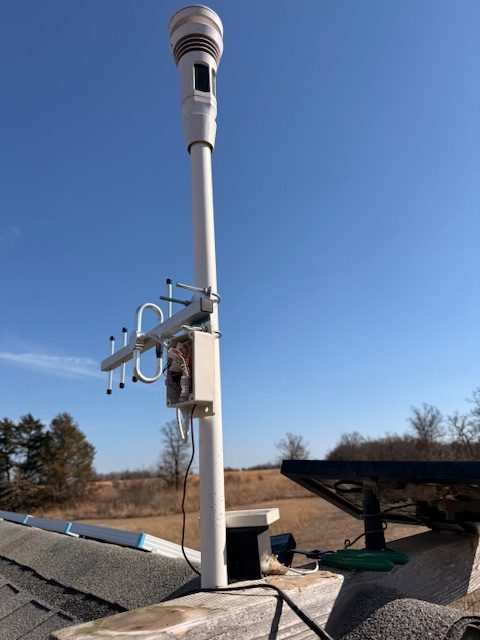
For fixed locations, a 915 MHz fiberglass antenna (~$35) with 5+ dBi gain is weatherproof and performs beautifully on a pole mount. For handhelds, an upgraded whip antenna (~$15) is a significant step up from stock while still being portable.
Setting Up Your First Network
Getting started is easier than you’d expect. Head to the Meshtastic web flasher, connect your device via USB, click “Flash,” and wait a couple of minutes. That’s the hard part — done.
Next, download the Meshtastic app (iOS / Android), turn on Bluetooth, connect to your node, and set a name and region (US for 915 MHz).
For a basic property network, you’ll want a home base node plugged into power in a central location, a mobile node for your truck or pocket, and remote nodes in the barn, at the gate, or wherever you need coverage. All nodes on the same channel will automatically mesh together.
One thing to remember: LoRa loves height and hates obstacles. Every foot of elevation helps, trees reduce range, hills block signals, and metal buildings reflect signals. A node on your roof will outperform one in your kitchen by 3 to 5 times.
Practical Use Cases
Farm and Ranch: Put a base station in the house with a WiFi connection for MQTT bridging, a node in each outbuilding, and a handheld for daily carry. Now you can text the barn to check on animals, get notifications at the gate, and communicate during tractor work — all without cell service.
Emergency Preparedness: Solar-powered nodes at key locations with battery backup and a handheld for each family member means communication survives even when cell service doesn’t. This matters a lot during the severe weather events we get out here.
Hunting and Recreation: Track locations via GPS-enabled nodes, send check-in messages, and coordinate with your group — all without cell service at camp.
Neighborhood Network: Get each household a node with one or more high-site repeaters, and suddenly your community has a communication layer for emergencies, sharing resources, and coordinating help.
Solar-Powered Remote Nodes
For truly off-grid locations, you can make a node completely self-sufficient with a minimal solar kit: a 6W solar panel (~$15), a TP4056 charge controller (~$6), an 18650 battery holder (~$8), and an 18650 battery (~$15). Total comes to about $45 on top of your node.
With the right power management settings — sleep after 5 minutes of inactivity, brief wakes to relay messages, deep sleep after 2 hours with no traffic — a well-designed solar node can run indefinitely.
Integrating with Home Assistant
If you’re running Home Assistant (and if you’re reading Rural Upload, there’s a good chance you are), Meshtastic nodes can feed data directly in via MQTT. Set up a broker on your HA instance, configure your node to use MQTT, and messages, GPS data, and telemetry all flow right in. You can trigger alerts when someone arrives at the gate, log environmental data from remote sensors, and send notifications via Meshtastic when HA detects issues. The MQTT integration guide on the Meshtastic docs covers the setup in detail.
What Kind of Range Should You Expect?
It depends heavily on terrain. In urban areas with a stock antenna, you’re looking at half a mile to a mile. Suburban gets you 1 to 2 miles. Out in flat rural terrain, 3 to 5 miles is typical, and upgrading the antenna pushes that to 5 to 10 miles. With high elevation and clear line of sight, community members have hit distances of 20 to 100+ miles. The record is over 200 miles in optimal conditions — but plan for 2 to 5 miles in typical rural terrain and you won’t be disappointed.
Starter Kit Recommendations
Budget (~$70): Two Heltec V3 nodes with upgraded antennas and USB cables you already have.
Proper Setup (~$200): One RAK WisBlock base station with a fiberglass antenna, plus two LilyGo T-Echo handhelds.
Full Property Coverage (~$400): Everything above plus additional nodes for outbuildings, a solar kit for remote locations, and antenna mounting hardware.
Common Mistakes
The biggest one: using stock antennas on base stations. Upgrading the antenna on your fixed nodes is the cheapest performance gain available. Second is poor placement — height matters more than almost anything else, and a node in your attic will always beat one on your desk. Don’t expect cellular-level range, configure power management settings on battery and solar nodes so you don’t drain them, and definitely check if there’s already a local mesh community at meshmap.net — you might get free extended range just by joining in.
Join the Oklahoma Mesh
If you’re in Oklahoma, check out okmesh.org for local node locations, community meetups, and tips for regional coverage. We’re building a statewide mesh network one node at a time.
Final Thoughts
Meshtastic hits a sweet spot for rural communication: cheap enough to experiment with, useful enough to rely on. Start with two nodes and you’ll quickly find reasons to add more. The technology is mature, the community is helpful, and the hardware is affordable. If you’ve ever wished for reliable communication across your property without cell service, this is your answer.
Questions? Drop them in the comments or join the Meshtastic Discord for community help.
This post contains affiliate links. Purchasing through these links supports Rural Upload at no extra cost to you.