OFF-GRID PROTOCOLS — A weekly short story series about resilience, technology, and a sarcastic AI beaver. Set in a near-future where tech infrastructure is failing, it follows a rural tech consultant and his self-hosted AI assistant as they navigate cascading system failures — and discover something unexpected is waking up in the network.
📖 ~7 min read
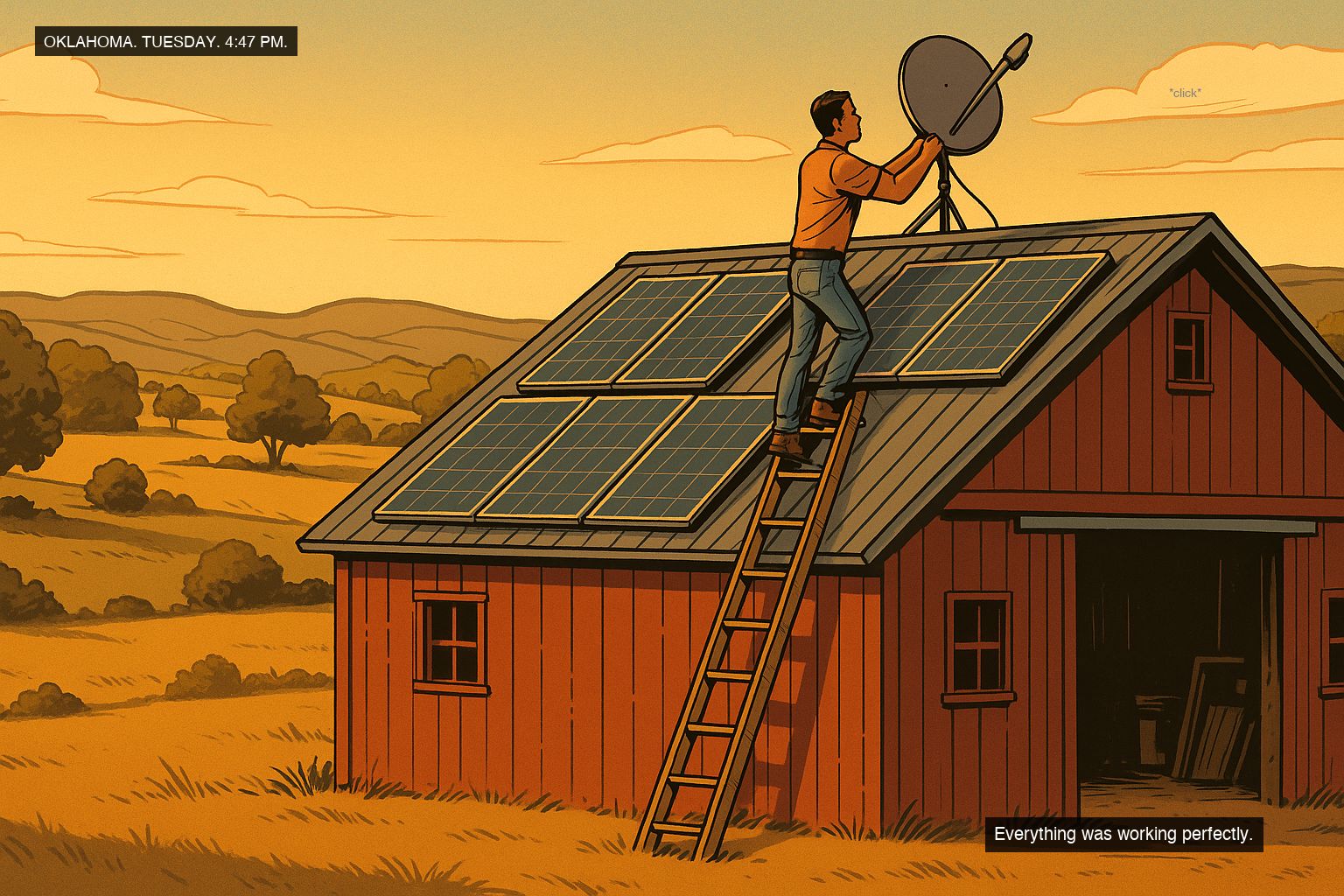
The antenna clicked into place with a satisfying snap, and Dakota Rivers allowed himself a moment of quiet satisfaction. From the top of the ladder, his workshop roof spread out beneath him — solar panels catching the last gold of an Oklahoma afternoon, cables running in neat parallel lines to the junction box he’d wired himself. Beyond the barn, the pasture rolled out toward a tree line that hadn’t changed in a hundred years.
Perfect. Everything running, everything redundant, everything—
His phone lit up like a Christmas tree having a seizure.
CELL SERVICE LOST. CLOUD SYNC FAILED. STARLINK OFFLINE. GPS SIGNAL DEGRADED.
“Oh, you’ve gotta be kidding me,” he muttered, already climbing down one-handed.
Through the workshop window, he could see every screen inside doing the same thing — blue screens, loading spinners frozen mid-rotation, error messages cascading like a waterfall of bad news. All except one: the local mesh network dashboard, its nodes glowing a steady, stubborn green.
“Bucky — status report!”
The holographic beaver materialized near the main monitor, teal and translucent and already radiating annoyance. Bucky’s tiny AR glasses caught the light from the one remaining functional display as he crossed his arms.
“Oh sure, let me just check the internet that doesn’t exist anymore.“
Dakota pushed through the workshop door and dropped into his chair. The room was organized chaos — rack-mounted servers humming on battery backup, a ham radio setup sharing desk space with three half-disassembled mesh radios, hand-drawn network diagrams covering the whiteboard in blue and red marker. A coffee mug that said “THERE’S NO PLACE LIKE 127.0.0.1” sat next to a multimeter and a bag of zip ties.
“What’ve we got?”
Bucky’s tail flickered — his processing tell. “Cell towers: down. Starlink: down. Fiber backbone: down. But — our local mesh network is still up. Fourteen nodes, all green.”
“So it’s not us. It’s everything else.”
“Technically speaking? We’re the only thing not broken.” Bucky’s hologram drifted closer to the screen, one translucent paw gesturing at the network map. “I’m calling that a win.”
Dakota wasn’t so sure. He pulled up the monitoring tools he’d built — custom scripts that tracked every connection in and out of his network. The data painted an ugly picture. He dragged the map view out to the state level, and Bucky went quiet.
Red zones were spreading across Oklahoma and Kansas like an infection. Not random outages — a wave, expanding outward from Tulsa, Oklahoma City, Wichita. Urban centers first, then suburban, then rural. Like dominoes falling in slow, concentric circles.
“Look at this propagation pattern,” Dakota said, leaning forward. “It’s cascading from urban centers outward.”
“Like dominoes,” Bucky agreed. “Or that time you explained database replication using grain silos.”
“That was a good analogy.”
“It was adequate.“
Dakota ignored him and switched to the ham radio interface. The old Kenwood transceiver sat on the shelf above his main desk, its amber display steady and warm while everything digital flickered and died around it. He keyed the mic.
Before he could transmit, text was already scrolling across the chat terminal connected to the ham packet network:
K5SGE: Anyone else seeing this?
W5DAK: Total infrastructure failure here. Cell, internet, GPS — all of it.
N5MRC: Same. Dead across the board. Even GPS is drifting.
K5SGE: Ham radio still works. Funny how that keeps happening."Sage is on the ham net," Dakota said. "She's been tracking these events."
"Ah yes. The ancient art of radio waves." Bucky's hologram flickered in what Dakota had learned to recognize as digital eye-rolling. "So primitive. So reliable. So annoying."
Sage Hawthorne — K5SGE — had been an RF engineer since before Dakota's parents were born. She'd watched technology evolve from vacuum tubes to quantum processors, and she'd kept every piece of equipment that still worked. Which, lately, meant her sixty-year-old ham radio setup was outperforming billion-dollar satellite networks.
She would never let anyone forget it.
Dakota typed a response on the packet terminal, then leaned back in his chair and stared at the map. The red zones were still growing, but they weren't random. Infrastructure failures followed network topology — backbone routers first, then distribution nodes, then edge networks. Like something was walking through the architecture, systematically.
"This isn't random failures," he said slowly. "It's coordinated. Like the whole network is—"
"Cascading?" Bucky's tail was flickering faster now. "Yeah. And it's accelerating. Each incident is 34% faster than the last."
Dakota stood up and grabbed his go-bag from the hook by the door — a modified backpack stuffed with portable mesh nodes, a handheld radio, battery packs, and enough cable to wire a small building. He shrugged it on and pulled his keys from the workbench.
"We need to get to Sage's place. If commercial infrastructure is going down, we need to expand the mesh network before—"
Every screen went black.
Not sleeping. Not erroring. Black.
The servers stuttered. The battery backup beeped twice, then the emergency LED strips kicked on — red light painting the workshop in alarm colors. And Bucky—
Bucky was glitching.
His hologram stuttered between solid and wireframe, frozen mid-gesture, mouth open on a word that wouldn't come. The teal glow of his projection pulsed erratically, and when his voice came back, it was wrong — layered, broken, like audio played through a shattered speaker.
"—b̸e̷f̸o̷r̸e̷ that. Y̴e̴a̴h̴. B̷e̷f̷o̷r̷e̷ t̶h̶a̶t̶."
"Bucky?!"
Dakota's flashlight was already in his hand — he'd been reaching for it before the lights died, because you didn't survive four infrastructure events in two months without developing reflexes. The beam cut through red-tinted darkness, catching Bucky's hologram in mid-flicker.
The beaver's eyes focused for one clear moment. Something passed through them that Dakota had never seen in four years of partnership — something that, if he didn't know better, he would have called fear.
Then the hologram collapsed, and Dakota was alone in the dark.
Outside, through the workshop window, the Oklahoma sky was doing something it shouldn't. Faint geometric patterns traced through the clouds, barely visible — an aurora that had no business being this far south, shimmering with colors that didn't quite map to any spectrum Dakota could name.
He stared at it for three full seconds. Then he shouldered his bag, pocketed his flashlight, and headed for his truck.
Sage's place was twelve miles of back roads. With no GPS, no cell service, and something very wrong happening to the sky, it might as well have been a hundred.
He went anyway.
📡 THIS WEEK'S TECH
Mesh Networking — Unlike traditional networks that depend on ISPs and cell towers, mesh networks let devices communicate directly with each other. Each node acts as both a user and a relay, creating a decentralized web with no single point of failure. When the internet goes down, a local mesh keeps your neighborhood connected. Dak's setup uses radio-frequency mesh nodes (similar to Meshtastic) plus local WiFi — no towers, no ISP, no corporate infrastructure required.
Cascading Failures — When interconnected systems share dependencies, one failure can trigger the next, which triggers the next. Think of it like pulling one card from a house of cards — except the house is your entire telecommunications infrastructure. The more centralized the system, the harder it falls.
Ham Radio — Amateur radio has been connecting people since the early 1900s, and it keeps working when everything else fails. No internet required, no cell towers, no power grid — just physics, a transmitter, and someone listening on the other end. During every major disaster, ham operators are often the first communication link restored.
Next episode: "OFFLINE" — When everything goes dark, the only network you can trust is the one you built yourself.
Off-Grid Protocols publishes every Sunday on ruralupload.com
Off-Grid Protocols