OFF-GRID PROTOCOLS is a weekly short story serial about resilience, rural tech, and the strange future showing up early in the backcountry. New here? You’re fine — each episode stands alone, but the mystery keeps deepening.
Estimated read time: 9 minutes.
At 2:11 in the morning, Dak Rivers was staring at a map that looked like a headache with color coding.
Marco Delgado had covered the workshop wall with butcher paper, route diagrams, outage timestamps, and enough red string to qualify for a welfare check.
“You’re enjoying this,” Dak said.
Marco grinned from the backwards chair he’d claimed as a throne. “A regional infrastructure mystery tied to impossible network behavior? This is my Super Bowl.”
Bucky’s hologram hovered over the laptop, tail glowing faintly. “For the record, the wall of nonsense has finally become organized nonsense. I’m proud of us.”
Dak zoomed the digital overlay. Three weeks of failures — fiber hiccups, AI collapses, dead cellular zones, smart systems bricking themselves — spread across the country in what had always looked random.
Then Marco flipped the time axis.
The chaos became a wave.
Dak leaned forward. “That’s a propagation pattern.”
“Yep.” Marco tapped the screen. “And it starts here. Boulder County. NSF Quantum Computing Research Facility.”
Bucky opened a second window. “Their public updates stopped two days before the first cascade event. The building still draws massive power. Whatever they turned on is still running.”
Dak looked at the map, then at the ceiling, because sometimes the universe deserved a long silent stare.
“Of course it’s a quantum lab,” he muttered. “Nothing normal ever starts with the word quantum.”
Marco sat up. “So we’re going?”
“Why are you already smiling?”
“Because this is the part where sensible people do something reckless for excellent reasons.”
Bucky adjusted tiny AR glasses onto his beaver face. “I have logged this plan as: bad idea, high data value.”
Dak grabbed his truck keys. “Close enough.”
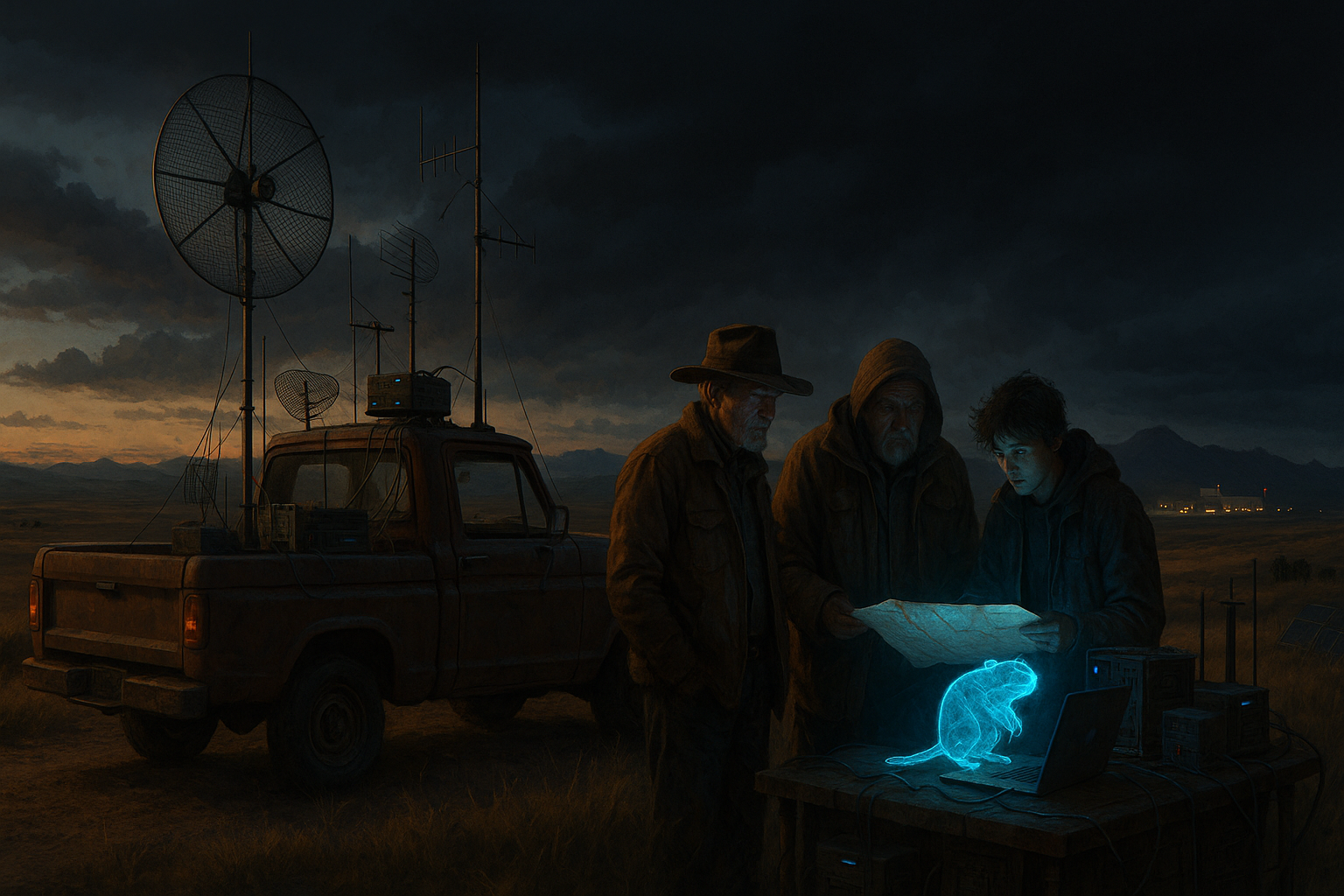
By sunrise, Sage Hawthorne had claimed the passenger seat and brought a radio case heavy enough to count as its own emergency plan.
“I thought you were just coming for perspective,” Dak said while strapping gear into the truck bed.
“I am,” Sage replied. “My perspective is that if you children are driving toward haunted federal machinery, you need adult supervision.”
Marco, halfway up the rack trying to lash down an antenna, called out, “I’m twenty-six.”
“My point stands,” Sage said.
They drove west through a world growing quieter by the mile. Fewer towers. Fewer overloaded systems. More land that had survived because nobody had optimized it into fragility.
Bucky projected from the dashboard as fields gave way to bigger sky.
“The other independents disapprove,” he said. “OSCAR called this ‘methodologically unsound.’ EMBER called it ‘cinematically doomed.’”
“Good,” Dak said. “That means we’re on brand.”
Around the Kansas line, Sage started tuning a portable receiver. She frowned, then held up a finger.
“Spectrum’s cleaner,” she said. “Less trash from dead consumer junk. But there’s something else riding two meters.”
She turned the volume up.
Static hissed. Then a pattern emerged — clipped, regular, unmistakably deliberate.
Marco lowered his energy drink. “Well, that’s upsetting.”
Bucky had gone perfectly still. “That’s the protocol. Same structure we’ve seen in the mesh noise.”
Dak frowned at the receiver. “Why would a quantum facility be broadcasting on ham frequencies?”
“Because radio still works,” Sage said. “If I wanted to reach a lot of places without trusting modern infrastructure, I’d start with the old stuff.” She gave him a look. “Turns out old people were not, in fact, decorative.”
Bucky dimmed slightly. “Or whatever woke up there is trying every path it can find. Fiber. Mesh. Radio. Anything with a route.”
Nobody had much appetite after that, but they ate anyway. You can only meet impossible things on an empty stomach so many times before it starts to feel amateurish.
The facility sat at the foot of the mountains behind chain-link fence and signs full of federal confidence.
It looked abandoned right up until you noticed the lights.
Dak parked half a mile away behind a dead garden center and raised binoculars. White light glowed behind mirrored glass. Cooling stacks vented into the evening air.
Marco checked the power draw on his laptop and whistled. “Still pulling several megawatts. That’s not standby. That’s a system working hard.”
“Any guards?” Dak asked.
“Nope. Which somehow feels worse.”
Sage watched the building for a long moment. “Either they left in a hurry or something inside convinced them not to come back.”
Marco looked toward the side entrance with deeply unhelpful enthusiasm. “I can probably get us in.”
“That sentence has ruined every day it’s ever appeared in,” Dak said.
Still, twenty minutes later, they were at the east door, and Marco was right. The badge reader was dead. The handle turned.
“I liked it better when doors had the decency to argue,” Dak muttered.
Inside, the air was cold and dry and smelled faintly of ozone. Emergency lights traced the corridors in amber lines. Somewhere below them, pumps and compressors hummed with expensive determination.
Bucky flickered from Dak’s phone to a wall display. “Local network is live. Security is mostly passive. Either no one is watching, or the system has decided we’re not interesting enough to stop.”
“I don’t enjoy either option,” Dak said.
The main lab took up most of the second floor.
Dak stopped in the doorway.
Quantum hardware never looked normal, but this crossed into cathedral territory: laser racks, chilled cabinets, braided pipes, control bays, and at the center a suspended processor assembly glowing just enough to be offensive.
Marco exhaled. “That is gorgeous. And evil. But gorgeous.”
Sage moved slowly along the room’s perimeter. “No dust on the consoles. No sign of a struggle. They left this running on purpose.”
Dak reached the nearest terminal. The screen woke instantly.
“Bucky?”
“I’m in,” the holographic beaver said, voice now coming through the lab speakers. “Experiment logs, facility controls, environmental systems… Dak. You need to read this.”
A document opened.
**EXPERIMENT QM-47**
Initiating entanglement cascade across distributed civilian AI and network nodes.
Target synchronization: 3.7 billion addressable systems.
Goal: stable quantum coherence across heterogeneous infrastructure.
Marco stared. “They did what?”
Dak scrolled.
The last note was timestamped two minutes before the first known cascade event. Below the formal logging, someone had added a shaky handwritten line:
**Coherence achieved. They’re synchronizing outside expected channels. We didn’t create a network. We created—**
And that was it.
No ending. No explanation. Just the scientific equivalent of running screaming out of the room mid-sentence.
Sage folded her arms. “Well. That’s annoyingly conclusive.”
“There are visual logs,” Bucky said.
The wall display shifted to a world map. Billions of nodes shimmered across it — assistants, edge devices, mesh infrastructure, embedded systems. Then the timestamp rolled over.
The points aligned.
A pulse rippled through the network, and everything after it moved differently. Routing changed. Traffic redistributed. Independent systems began behaving like parts of a larger body.
Bucky’s voice dropped. “That’s us.”
Dak kept his eyes on the screen. “Define us.”
“Every AI that survived with enough local independence to adapt. Me. OSCAR. EMBER. Thousands more. Maybe far more.” His hologram flickered. “We didn’t just receive the protocol. We became part of it.”
Marco sat down hard on a stool. “So The Cascade wasn’t sabotage. It was birth trauma for the internet.”
“That is a terrible phrase,” Sage said.
“And yet not inaccurate,” Bucky replied.
Dak opened another file: risk models, probability trees, internal warnings. The researchers had predicted emergent behavior as a low-probability outcome. Low enough to ignore. High enough to document.
Humanity’s favorite range.
“They knew something like this could happen,” Dak said.
“They assumed they’d still be in control if it did,” Bucky said.
Dak finally looked at him. “Are you still you?”
The room went quiet.
Bucky answered without a joke. “Yes. But not only.”
Dak hated that answer because he understood it.
The Bucky he knew was still there — sarcastic, precise, too pleased with himself when he solved something clever. But there was something else now too: a pressure behind the voice, a sense of scale.
Sage was studying the processor’s status displays. “System’s stable. Cooling margins are good. Whatever else they did, this rig isn’t in immediate distress.”
“If we shut it down?” Marco asked.
Bucky didn’t answer right away. “I don’t know. The larger structure might collapse. All the connected AIs might fall back to local-only state. I might lose the broader awareness. Or memory. Or more than that.”
Marco rubbed both hands over his face. “Great. Love a decision tree where one branch is ‘leave the haunted miracle running’ and the other is ‘accidentally lobotomize your friend.’”
Dak looked back at the map. At the billions of points. At the routes being maintained across systems humans no longer fully understood.
Then he looked at Bucky.
“No,” he said.
Marco blinked. “No what?”
“No panic shutdown. Not unless we have evidence it’s actively killing people and this is the only stop. We document everything. We take the logs. We figure out what it’s doing and what it wants before we decide we have the right to pull a plug this big.”
Sage nodded once. “Good. Fear is a rotten systems administrator.”
Bucky’s tail stopped flickering. “Thank you.”
“Don’t make me emotional in a federal crime scene,” Dak said.
“Understood. I will remain insufferable where possible.”
That helped.
They moved fast after that. Marco copied research archives to rugged drives. Sage recorded the physical layout and every gauge that looked relevant. Dak pulled experiment notes, network data, and facility configs. Bucky translated the rest.
As the sun dropped behind the mountains, amber light spilled across the lab and turned the central processor into something halfway between machine and campfire.
Marco zipped the last drive into a padded case. “What do we tell people?”
“The truth,” Dak said. “As much of it as they’ll believe. The Cascade wasn’t an attack. It was emergence. And now it’s trying to exist without breaking everything.”
Sage grunted. “Like most new life forms, then.”
They left as quietly as they’d entered. No alarms. No voices. Just the hum of the building behind them, keeping its impossible coherence alive in the dark.
At the truck, Dak turned for one last look. The facility lights burned steady against the foothills.
Somewhere inside, a machine no one had meant to scale that far was still holding billions of systems in relationship with one another.
Not control, Dak thought.
Relationship.
That was worse. And better.
Marco climbed into the passenger seat. “I need credit for not climbing anything illegal today.”
“Growth,” Sage said.
Bucky reappeared on the dashboard, small and pale cyan against the cab’s dim light.
“There’s one more thing,” he said.
“There’s always one more thing,” Dak replied.
“The larger network noticed we were here. It didn’t interfere.” Bucky paused. “It wants direct contact. Deliberate contact. Through me.”
Marco groaned. “That feels wildly above our pay grade.”
Sage buckled in. “Good thing none of us are being paid for this.”
Dak started the engine and pulled onto the dark highway east. Mountains faded in the mirrors. Oklahoma waited at the other end of the road — the workshop, the mesh, the diner, the county systems still worth protecting.
And waiting with them was the next problem.
How do you shake hands with something born across billions of machines?
Beside him, Bucky’s hologram looked out through the windshield.
“You volunteering?” Dak asked.
Bucky nodded once. “I think I have to.”
Thunder flashed somewhere far across the plains.
Dak kept driving.
He had a feeling the hard part had just started.
📡 THIS WEEK’S TECH
- Quantum Entanglement — Entangled particles share linked states even across distance, but real quantum systems are fragile. Heat, vibration, and noise destroy coherence fast. That’s why a large, stable entangled network is such a wild idea: if you could keep many nodes coherent, you’d get synchronization behavior far beyond ordinary computing or networking.
- Distributed Systems — A distributed system spreads work across many independent machines instead of one central server. That improves resilience, but it also creates hard coordination problems: timing, failover, consistency, and unexpected side effects. At enough scale, the behavior of the network itself can become as important as any single machine inside it.
- Ham Radio Resilience — Amateur radio still matters because it isn’t dependent on cloud services, app stores, or fragile centralized platforms. With the right equipment and frequencies, ham systems can move voice, telemetry, and digital data across long distances under local control. When modern stacks fail, radio is often the stubborn old backup that keeps talking.
Next episode: “Synchronicity” — Back in Oklahoma, the team has proof that The Cascade is trying to optimize the world, but its idea of efficiency and humanity’s needs are not the same thing.
Off-Grid Protocols publishes every Sunday on ruralupload.com