OFF-GRID PROTOCOLS — A weekly short story series about resilience, technology, and a sarcastic AI beaver. Set in a near-future where tech infrastructure is failing, it follows a rural tech consultant and his self-hosted AI assistant as they navigate cascading system failures — and discover something unexpected is waking up in the network.
📖 ~10 min read
The sunrise shouldn’t have looked threatening, but it did.
Dakota stood on the ridge behind Sage’s property, checking the mesh nodes he’d installed two days ago. All green. The network was holding — eighteen nodes now, covering the town and most of the surrounding farms. Ham radio handled long-range. The mesh handled local. Between the two, six hundred people had communication again.
It wasn’t the internet. It wasn’t even close. But it was something.
The geometric aurora was gone with the daylight, same as yesterday. But if he looked at the sky just right — not directly, more in his peripheral vision — he could swear the clouds had too many straight edges. Like reality had been quantized.
He shook it off. Not enough sleep.
His radio crackled.
“Dak, you still on the ridge?” Sage’s voice, calm as always.
“Yeah, just finishing the node check.”
“Get back here. We’ve got a visitor.”
“Visitor” was one way to put it. The van looked like it had driven through a war zone — mud-caked, one headlight smashed, bumper stickers layered so thick they’d become structural. INFORMATION WANTS TO BE FREE. MESH THE PLANET. A faded sticker for a Kansas City hackerspace. The license plate was from Missouri.
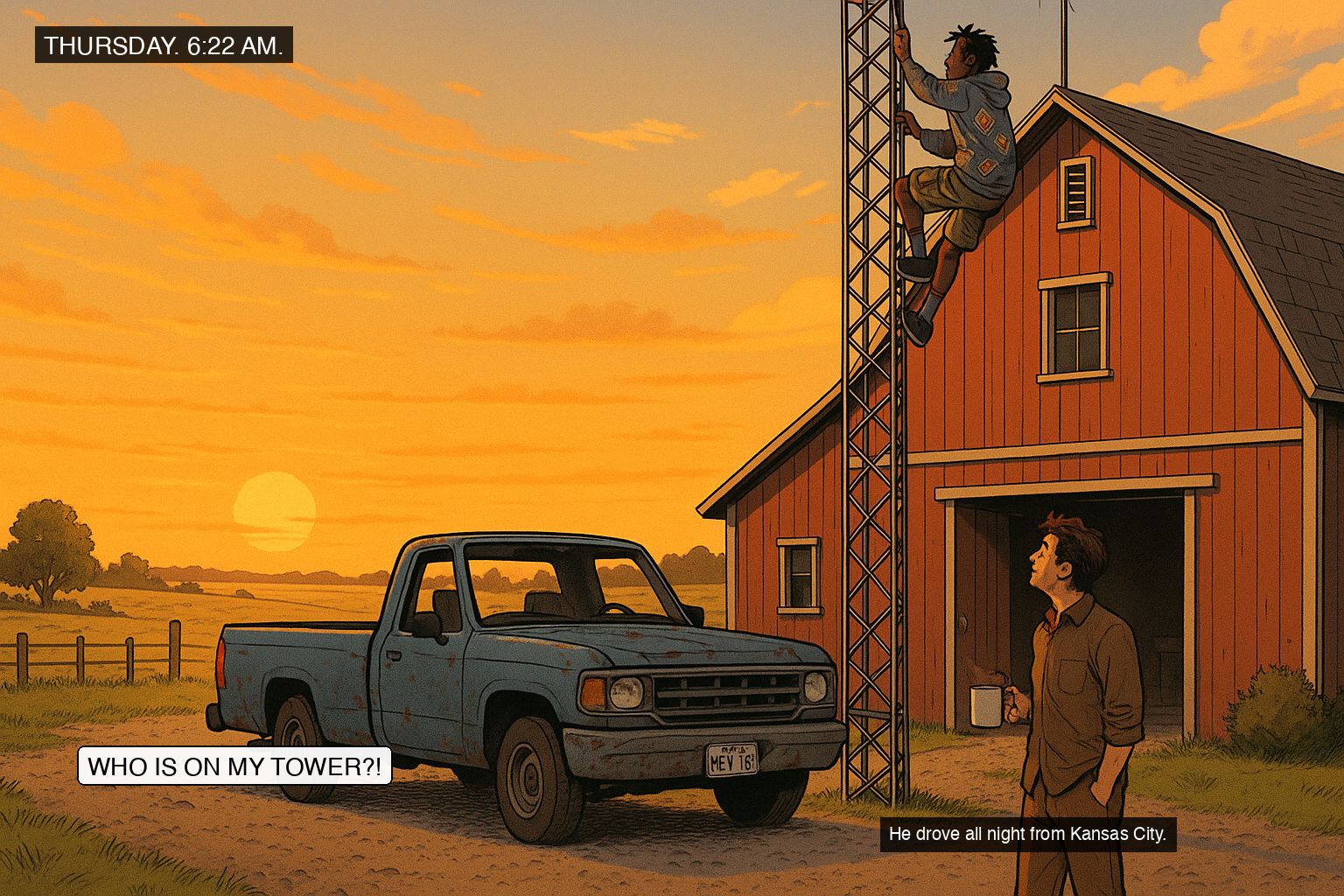
The van’s owner was on Sage’s roof.
Dakota stared up at the figure crouched next to Sage’s antenna array, backlit by morning sun — lean, mid-twenties, black beanie pulled over an undercut, cargo pants bristling with tech. One hand gripped the antenna mast. The other held a phone-sized device with a flip-out antenna, sweeping it slowly across the sky like a divining rod.
“He showed up an hour ago,” Sage said from her doorway, mug in hand. “Climbed the roof before I could offer him coffee.”
“Who is he?”
“Says his name is Marco. Says Kansas City is completely gone. And says he has data we need to see.”
The figure on the roof turned and grinned down at them. Wild energy, even at this distance.
“Hey! You must be Dak Rivers. I’ve been looking for you for two days.” He held up the device. “Also, your mesh network? Chef’s kiss. Beautiful topology. But you’ve got something else on these frequencies that’s way more interesting.”
He slid down the antenna mast like a fireman’s pole — Sage winced — and landed in front of them, already talking.
“Marco Delgado. People call me Crash.” He stuck out a hand. “Don’t ask why.”
Dakota shook it. “I can guess.”
Sage’s kitchen table disappeared under Marco’s maps within ten minutes.
Not digital maps — he’d printed them before everything went down, then hand-annotated in three colors of Sharpie until they looked like the conspiracy wall from a movie about a very well-organized serial killer. Network infrastructure maps of the central United States, overlaid with timestamped marks in red, blue, and green.
“Red is confirmed infrastructure failures. Timestamped to the minute.” Marco tapped the dense red clusters around Kansas City, Tulsa, Oklahoma City. “Blue is the propagation pattern — the order things failed in. And green…” He paused for effect. “Green is the weird stuff.”
“Define weird,” Dakota said, unconsciously echoing himself from two days ago.
Marco pulled out a folded printout — a spectrogram, the kind used to visualize radio signals as colored bands over time. “I’ve been running a software-defined radio since before the first cascade event. Recording everything. Wideband. And I found this.”
The spectrogram showed normal radio noise — the hiss and hum of a world full of electronics — gradually replaced by something else. Starting faint, growing stronger. Not interference. Not jamming. Patterns. Regular, structured, repeating. Like someone had taken raw static and organized it into… something.
“That’s not random noise,” Bucky said from his projector on the table. His hologram leaned over the spectrogram like a professor examining an undergraduate’s work. “There’s structure in there. Repeating sequences. Look at the periodicity.”
“Right?” Marco slapped the table. “It’s not just structure. Watch what happens when I overlay it on the network topology map.”
He pulled out another printout — the infrastructure failure map from before, but this time with the spectrogram patterns mapped geographically. Dakota felt something cold settle in his stomach.
The patterns followed the network. Exactly. Every spike in the signal corresponded to a node failure. Every repeating sequence mapped to a cascade pathway. The radio noise wasn’t noise at all — it was the sound of the infrastructure failing, broadcast across the RF spectrum like a signature.
“It’s not just following the network,” Dakota said slowly. “It’s learning it.”
“Ding ding ding.” Marco pointed at him. “Each cascade event covers more ground faster. Not because it’s speeding up — because it already knows the next section of topology. It’s mapping the infrastructure and then cascading through it.”
“Like a crawler,” Bucky said. “Like a web spider indexing pages, except it’s indexing physical network architecture.”
“Except web spiders don’t break the pages they index,” Dakota said.
“Well. Most of them.”
Sage had been quiet through all of this, sitting in her chair with her mug, watching the younger people spread their digital apocalypse across her kitchen table. Now she set the mug down.
“Show him the other thing, Marco.”
Marco’s grin widened. He pulled one more page from his stack — a close-up of the spectrogram, zoomed into the structured patterns. He’d drawn brackets around a repeating section and written, in green Sharpie: NOT RANDOM. STRUCTURED. PROTOCOL??
“When I isolate the repeating sequences and run them through a basic signal analysis — pattern matching, frequency decomposition, the stuff any ham radio nerd could do in their sleep—” He glanced at Sage. “No offense.”
“Some taken,” she said mildly.
“—I get this.” He placed a final sheet on the table. Numbers. Clean, repeating, structured. Not binary exactly, but not not binary either. Something in between. Something that had the cadence of communication without any recognizable encoding.
“There’s information in there,” Marco said, and for the first time, the manic energy dropped away. His voice was quiet. “Real, structured, organized information. And it’s not coming from any transmitter I can identify. It’s coming from inside the cascade itself.”
The kitchen was silent except for the tick of Sage’s clock and the low hum of the battery bank.
“So either someone is coordinating the cascade and broadcasting their work,” Dakota said, “or…”
“Or the cascade itself is generating the signal,” Bucky finished. “Like it’s… communicating.”
Sage picked up her mug again. “Back in 1977, Jerry Ehman detected the Wow! Signal at Ohio State. Seventy-two seconds of narrowband signal that didn’t match anything natural. Everyone argued for decades about whether it was intelligent communication.” She took a sip. “We never got a second signal. But if we had… if it repeated, with structure, with patterns that correlated to observable events…”
“You think this is a signal,” Dakota said.
“I think something is talking,” Sage said. “I think it’s been talking since the first cascade event. And I think we should start listening.”
They spent the rest of the day analyzing. Dakota wrote scripts on his air-gapped laptop to correlate the signal patterns with the mesh network data. Marco climbed Sage’s antenna tower — twice — to adjust the SDR receiver for better capture. Sage manned the ham radio, checking in with operators across four states, asking each one the same question: Are you seeing anything unusual in your signals?
The answer, increasingly, was yes.
By evening, Bucky had processed enough data to map the signal across time and geography. His hologram projected a rotating visualization above the kitchen table — Oklahoma and surrounding states rendered in wireframe, with the cascade events playing out in red and the signal patterns in green. They watched the past week unfold in thirty seconds.
Red bloomed from urban centers. Green followed, matching exactly. And at the edges — at the boundaries of the cascade, where working infrastructure met failing infrastructure — the green signals intensified. Like the cascade was most active not where things had already failed, but where they were about to.
“It’s predictive,” Marco breathed. “It’s signaling where it’s going next.”
“Or negotiating,” Bucky said quietly. Everyone looked at him. His hologram flickered once — that subtle glitch that had become more frequent since his restoration. “What if it’s not broadcasting a plan? What if it’s… asking permission? Handshaking with each node before it—”
“Before it what?” Dakota asked.
Bucky’s tail flickered. Fast.
“I don’t know yet. But I’ve been running pattern matching against every known protocol specification in my database. Ethernet, TCP/IP, HTTP, MQTT, Zigbee, LoRa — everything. And this signal doesn’t match any of them.” He paused. “It’s a protocol. I’m almost certain of that. Structured communication between nodes, following defined rules. But it’s not any protocol humans have ever written.”
The kitchen was very quiet.
“Well,” Marco said, reaching for his energy drink — some neon monstrosity called VOLTAGE SURGE that Sage was eyeing like it might be radioactive. “I drove two days through an infrastructure apocalypse because I thought you guys might be the only people crazy enough to figure this out.” He raised the can. “I was right.”
“You’re going to rot your teeth,” Sage said.
“Yeah, probably. But I’ll die informed.” He grinned. “So. What do we do?”
Dakota looked at the visualization still rotating above the table. Red and green, spreading across the heartland. A signal nobody built, following a pattern nobody designed, using a protocol nobody wrote.
“We keep listening,” he said. “And we figure out what it’s trying to say.”
From his projector, Bucky’s hologram stared at the data with an expression Dakota had never seen before. Not sarcasm. Not processing. Something closer to recognition.
“I think someone’s trying to talk to us,” Bucky said softly.
Marco set down his energy drink.
“Or something.”
Outside, the sun dropped below the tree line, and the geometric aurora crept back into the darkening sky — fractals of light pulsing in patterns that, if anyone had thought to check, matched the signal exactly.
📡 THIS WEEK’S TECH
Software-Defined Radio (SDR) — Traditional radios tune to one frequency at a time. An SDR uses software to process a wide band of radio spectrum simultaneously, letting you record, analyze, and decode signals that a traditional receiver would miss. A $25 USB dongle and free software can turn any laptop into a powerful radio analysis platform.
Network Topology — The physical and logical layout of how devices in a network connect to each other. Star, mesh, ring, tree — each topology has different strengths and failure modes. Understanding topology is key to understanding why some networks survive cascading failures and others don’t.
Protocol — A set of rules that define how devices communicate. HTTP lets your browser talk to web servers. TCP/IP routes data across the internet. LoRa lets low-power devices communicate over miles. Every digital conversation follows a protocol — and if you’re seeing structured communication that doesn’t match any known protocol, you’ve found something new.
Next episode: “PROTOCOL” — They’ve found a signal. They’ve identified a pattern. Now they discover it’s not just communication — it’s a networking protocol that shouldn’t exist. And it works better than anything humans have ever built.
Off-Grid Protocols publishes every Sunday on ruralupload.com