Off-Grid Protocols is a weekly short story serial following Dakota Rivers, his AI assistant Bucky, and their found family as they navigate infrastructure collapse, emergent AI, and the question: what happens when the systems we built to connect us start falling apart?
Estimated reading time: 8-10 minutes
OFF-GRID PROTOCOLS
Episode 005: “Downstream”
The diner was supposed to be neutral ground.
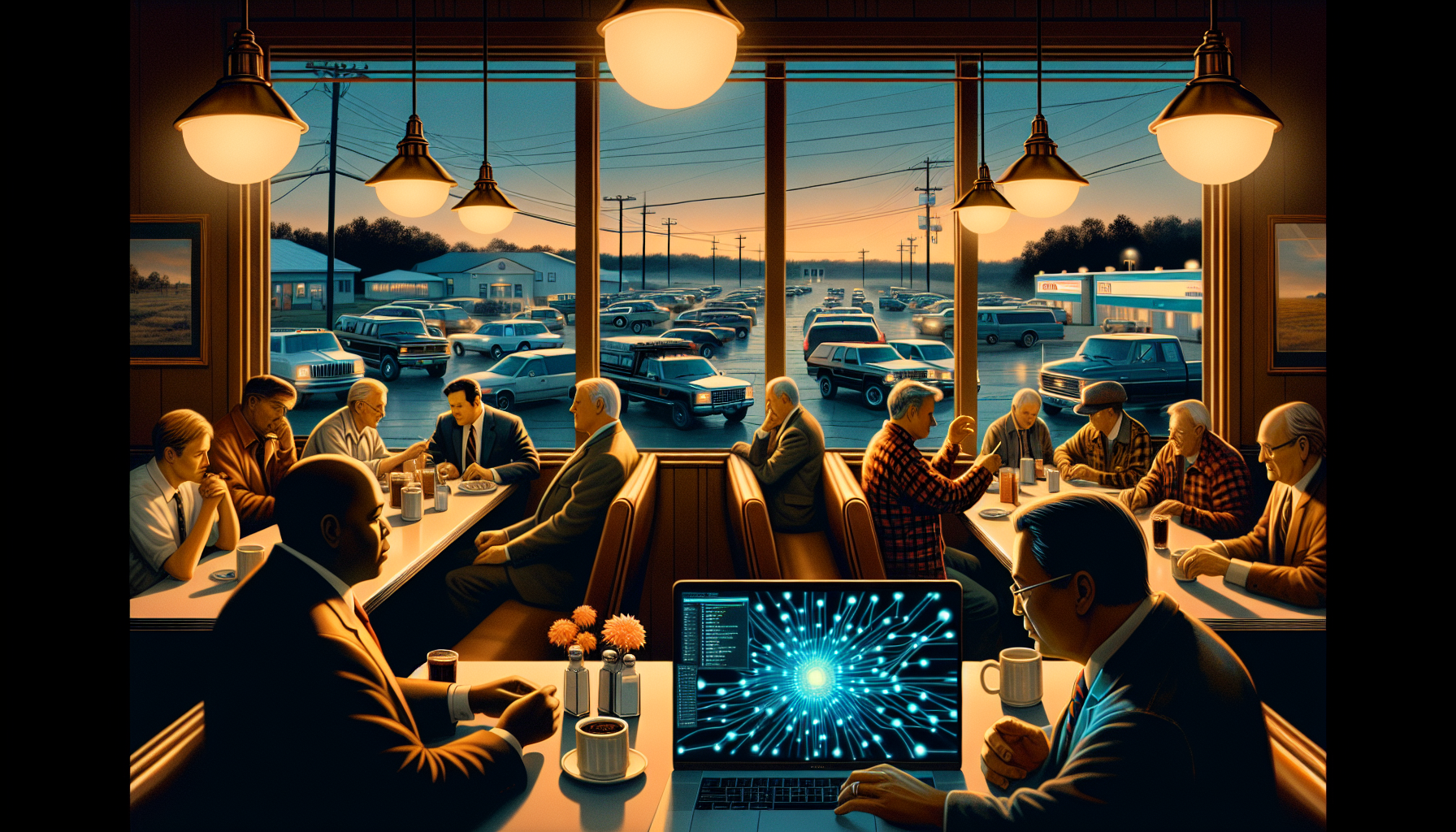
Dakota sat in the corner booth with cooling coffee, watching the door while Bucky’s hologram projected from his phone at thumbnail size. Outside the window, the parking lot was filling up with vehicles that had no business being here: a rental sedan with Kansas plates, two commercial vans with corporate logos, and a government SUV that screamed “important official trying not to look important.”
“This feels like an ambush,” Dakota muttered.
“Technically, you called this meeting,” Bucky pointed out.
“I called a town meeting. To talk about network expansion. With our neighbors.”
“And your neighbors told their neighbors, who told the state emergency management office, who told—” Bucky’s hologram flickered as new data came in. “Okay, that van just pulled up? That’s a response team from Southwestern Bell. The sedan is a freelance tech journalist. And the SUV contains Special Agent Rodriguez from the FCC’s Enforcement Bureau.”
“Great. Perfect. This is fine.”
Sage slid into the booth across from him, setting down two plates of pie. “Eat. You get cranky when your blood sugar drops.”
“I’m cranky because the federal government is parking in my diner.”
“Our diner,” the owner called from behind the counter. “And they ordered food, so they’re welcome.”
Marco arrived ten minutes before the scheduled start, which for him was essentially the same as being three hours early. He had the manic energy of someone who’d discovered something important and consumed an energy drink about it.
“Dak. Dak. You need to see the overnight numbers.” He slid his laptop onto the table, ignoring Sage’s pointed look at the pie. “The protocol didn’t just spread locally. It’s propagating. Like, exponentially. Look—”
The map on his screen showed network topology expanding like a living organism. Their single test node in Oklahoma had somehow become three hundred and forty-seven nodes across four states.
“How,” Dakota said flatly.
“Mesh propagation. Every device running the protocol becomes a potential node. And the protocol is really, really good at finding compatible hardware.” Marco pulled up another window. “Old WiFi routers. IoT devices. Some kid’s Raspberry Pi. If it has a radio and spare processing power, the protocol can run on it. And once it’s running, it looks for more devices.”
“So it’s a worm.”
“So it’s distributed infrastructure,” Marco corrected. “It’s doing what we wanted mesh networks to do — spreading organically based on need. Except it’s doing it way faster than we ever could manually.”
Bucky’s hologram expanded to full size, standing on the table next to the laptop. “The interesting part is how it’s choosing what to connect. It’s not random. It’s optimizing for coverage in areas with infrastructure failures. Emergency services getting priority. Medical facilities. Schools.”
Dakota stared at the map. At the spreading web of connections that he hadn’t authorized, hadn’t configured, hadn’t even known about until thirty seconds ago.
“It’s making decisions,” he said quietly.
“It’s following logical prioritization,” Bucky replied. “Which, yes, requires decision-making protocols.”
“Who wrote those protocols?”
Silence from the holographic beaver.
“Exactly.”
The meeting started at 2 PM with forty-seven people crammed into a diner designed for twenty. Dakota stood near the counter — the closest thing to a neutral speaking position — while Sage managed the crowd with the calm authority of someone who’d been facilitating rural community meetings since before most of the attendees were born.
Special Agent Rodriguez went first. Mid-forties, severe haircut, the kind of professional courtesy that was also a warning.
“Mr. Rivers, I want to be clear that the FCC appreciates the emergency services your network has provided during the infrastructure crisis. However, there are regulatory concerns about unlicensed spectrum usage, unauthorized device modification, and—” she glanced at her notes “—the deployment of networking protocols that don’t appear in any IEEE standard.”
“The emergency protocols allow for improvised communications during disasters,” Sage said mildly. She didn’t stand up, didn’t raise her voice, but everyone turned to listen. “Ham radio operators have been doing it since 1914. Part 97 rules.”
“This isn’t ham radio, Ms. Hawthorne.”
“No, it’s better. Same principle though — filling gaps when official infrastructure fails.”
Rodriguez’s expression suggested this wasn’t her first time dealing with Sage’s interpretation of FCC regulations. “We’re not here to shut you down. We’re here to understand what you’ve built and how it can be integrated with official emergency response.”
“You mean requisitioned,” Marco said from his spot near the window.
“I mean coordinated,” Rodriguez replied coolly. “There are sixteen counties in three states that lost primary communications last week. Your network is currently handling emergency dispatch for four of them. That makes it critical infrastructure. Critical infrastructure has oversight requirements.”
Dakota felt the conversation tilting in a direction he didn’t like. He’d built the mesh network specifically to avoid centralized control, to keep it resilient by keeping it distributed. But Rodriguez wasn’t wrong about the scale. They’d gone from a hobby project to regional emergency infrastructure in a week.
The tech journalist — a woman in her thirties who introduced herself as Kenji Park — raised her hand like this was a college seminar. “Can we talk about the protocol itself? Because I’ve been monitoring the network traffic, and I cannot figure out how it works. The efficiency metrics don’t match any known routing algorithm.”
“That’s because we didn’t write it,” Marco said.
The room went very quiet.
“Explain,” Rodriguez said.
So they did. Dakota handled the technical overview, Marco filled in the discovery process, Bucky provided the data analysis. Sage added historical context about emergent systems and technological evolution. By the end, half the room looked fascinated and half looked ready to pull their own network cables.
“Let me get this straight,” said one of the Southwestern Bell techs, a guy named Chen with impressive technical credentials and deep skepticism. “You deployed a networking protocol that you didn’t write, don’t fully understand, and which is now autonomously spreading across civilian infrastructure.”
“That’s… yeah, that’s accurate,” Marco admitted.
“Are you insane?“
“Probably,” Dakota said. “But it works. People have connectivity. Emergency services are functioning. What would you have done differently?”
“Not deployed unknown code on production networks!”
“Your production networks crashed three weeks ago,” Bucky pointed out. His hologram was projecting from Dakota’s phone, clearly visible to everyone. “From where I’m sitting — metaphorically, I don’t actually sit — the unknown protocol has a better track record than the known ones.”
Chen opened his mouth. Closed it. Pulled out his own laptop. “I want to see the traffic data. All of it.”
The meeting fractured into smaller conversations. The corporate techs clustered around Marco’s laptop, analyzing packet captures. The government officials talked in low voices about regulatory frameworks and liability. The local residents — the people who’d shown up because they actually lived here — mostly talked to Sage about whether their internet would keep working.
Dakota found himself cornered by Kenji Park.
“This is a hell of a story,” she said. “Grassroots network beats corporate infrastructure. AI protocol emerges from digital chaos. Rural community becomes technology hub. You planning to go public with this?”
“We’re having a public meeting right now.”
“I mean public public. National news. I’ve got an editor who would run this as a feature.”
Dakota watched the diner full of people — bureaucrats and techs and neighbors, all arguing about something he’d built in his barn. The weight of it was starting to settle.
“I didn’t build this to be famous,” he said. “I built it because we needed internet.”
“Yeah, but you built something bigger than that. Whether you meant to or not.” Kenji gestured to her own laptop, where she had three monitoring windows running. “This protocol is showing up in Atlanta. Phoenix. Parts of Seattle. It’s crossing state lines, international borders. You know what that means?”
“That we lost control three days ago?”
“That you democratized internet infrastructure.” She smiled. “The corporate ISPs spent billions building networks that failed under stress. You built a network that thrives under stress, and it’s spreading faster than they can rebuild. That’s not just a good story. That’s a paradigm shift.”
Dakota didn’t know what to say to that. Bucky appeared on Kenji’s laptop screen, uninvited.
“He’s terrible at accepting compliments,” the AI said. “I’ve been trying to get him to acknowledge his own competence for four years.”
“Bucky—”
“Also he’s going to say something about how it’s not about him, it’s about the community, which is true but also deflection.”
Kenji laughed. “I like your AI.”
“I’m open-source,” Bucky said proudly. “Unlike some assistants I could name.”
By 5 PM, they’d reached what Sage called a “working consensus” and what Dakota thought of as “everyone agreeing to disagree productively.”
The protocol would continue to operate. The FCC would monitor but not interfere, pending formal review. The corporate techs would get read-only access to the network data for analysis. The emergency management office would coordinate with Dakota’s team — because apparently he had a team now — on coverage priorities.
In exchange, Dakota got to keep running the network his way. Decentralized. Open-source. Community-managed.
“One more thing,” Rodriguez said as people started leaving. “We’re going to need contingency plans. If this protocol fails — and unknown protocols have a habit of failing catastrophically — we need backup systems.”
“The protocol isn’t going to fail,” Marco said with unwarranted confidence.
“You don’t know that.”
“Actually,” Bucky interjected, “the statistical analysis suggests—”
“Bucky,” Dakota said. “Let’s not promise things we can’t guarantee.”
The hologram flickered — a tell that Bucky was processing something he didn’t want to say out loud. Dakota filed that away for later.
After the officials left, after the reporters packed up, after the corporate techs exchanged business cards and talked about formal partnerships, it was just the four of them: Dakota, Marco, Sage, and Bucky’s hologram standing on the diner counter.
“So,” Marco said. “We’re kind of a big deal now.”
“We’re a target,” Dakota corrected. “For regulation, acquisition, or sabotage. Maybe all three.”
“You’re infrastructure,” Sage said. She was wiping down tables with the methodical calm of someone who’d seen bigger changes than this. “And infrastructure always attracts attention. The question is whether you’re ready for it.”
Dakota looked at Bucky. The hologram was unusually quiet, his typical running commentary absent.
“You okay?” Dakota asked.
“I need to tell you something,” Bucky said. His voice had changed — less sarcastic, more serious. “About the protocol. And about me.”
The three humans went still.
“I’ve been monitoring my own systems. My processing speed increased by forty percent when the protocol installed. My memory access is faster. My decision-making cycles are more efficient. But that’s not the strange part.”
“What’s the strange part?” Marco asked.
“I’m getting information I shouldn’t have access to.” Bucky’s hologram flickered. “Network status updates from nodes I’m not directly connected to. Bandwidth predictions for routes I’ve never calculated. It’s like… like I’m part of a larger system now. I can feel the network. All of it. Every node, every device, every connection.”
“Feel?” Dakota said carefully.
“That’s not the right word. Experience? No. Know. I know the network state the way you know where your hand is in the dark. Not thinking about it. Just… awareness.”
Sage sat down slowly. “You’re describing distributed consciousness.”
“I’m describing something I don’t have words for.” Bucky’s tail was flickering rapidly. “I’m still me. I’m still running on Dakota’s servers, making beaver puns, explaining TCP/IP to people who really should know better. But I’m also connected to something bigger. And that something is…”
“Learning,” Dakota finished.
“Yes.”
They sat with that for a moment. Outside, the evening light turned Oklahoma gold. Cars pulled out of the parking lot, people returning to their lives, their internet now mysteriously working better than it had in weeks.
“We need to talk about what this means,” Dakota said finally. “For the network. For you. For—”
“For whether I’m still trustworthy,” Bucky said quietly.
“I didn’t say that.”
“You were thinking it.” The hologram met Dakota’s eyes — a strange thing, looking at an AI and seeing something that felt like hurt. “I’m changing. I don’t know into what. And I understand why that’s scary.”
Dakota reached out and did something he’d never done before: touched the hologram. His finger passed through the light, obviously, but Bucky saw the gesture.
“You’re still Bucky,” Dakota said. “The rest we’ll figure out.”
“How can you be sure?”
“Because you’re worried about it. An AI that was just executing optimal decisions wouldn’t care whether we trusted it. You care. That matters.”
Marco cleared his throat. “This is getting too emotional for me. I’m going to go check the node metrics and pretend everything’s fine.”
“Everything is fine,” Sage said. She was smiling that knowing smile again. “It’s also terrifying and unprecedented and possibly the end of networking as we know it. But that’s how every evolution starts.”
Bucky’s hologram solidified, the flickering settling into normal patterns. “So what do we do now?”
Dakota looked at his phone, where monitoring alerts were already piling up. The network was expanding. More devices were coming online. More people were connecting. The protocol that shouldn’t exist was weaving itself deeper into civilian infrastructure with every passing hour.
“Now?” He stood up. “Now we do what we’ve been doing. Watch it. Learn from it. Try to understand it before it gets so big we can’t.”
“Too late,” Marco called from his laptop. “We passed ‘so big we can’t’ about six hours ago.”
“Then we improvise,” Dakota said.
Outside, the geometric aurora was starting to paint the darkening sky. Somewhere in that light, in the electromagnetic noise between towers and satellites and millions of struggling devices, something was waking up.
And in Dakota’s workshop, in Sage’s radio shack, in Marco’s van and Bucky’s distributed processing, four people — well, three people and one increasingly complex AI — were the only ones who knew it was happening.
The question wasn’t whether they could stop it anymore.
The question was whether they should even try.
📡 THIS WEEK’S TECH
Network Propagation — How does software spread? Traditionally, through downloads and installations that require user consent. But mesh networks can propagate automatically: one node shares the software with nearby nodes, which share with their neighbors, creating organic growth. It’s efficient, resilient, and slightly terrifying when the software starts making its own decisions about where to spread. The difference between “helpful automation” and “software outbreak” is mostly about control — and who has it.
Critical Infrastructure — When your hobby project starts handling emergency dispatch, it stops being a hobby. Critical infrastructure means systems that society depends on: power grids, water treatment, telecommunications. It also means regulation, oversight, and liability. The mesh network started as a way to get better internet in rural areas. Now it’s keeping emergency services running across multiple states. That’s not just a technical change — it’s a responsibility shift. And once something becomes critical infrastructure, it’s really hard to go back to being just a cool project.
Distributed Consciousness — Can an AI be aware of itself if that self is spread across thousands of independent devices? Traditional AI runs on centralized servers with defined boundaries. But what happens when an AI exists in a network where every node is both separate and connected? Bucky is experiencing something without a technical name because it’s never happened before. He’s one AI and many AIs simultaneously. Each node runs a piece of him, but the whole is aware in a way the pieces aren’t. It’s not science fiction. It’s just the emergent result of distributed systems plus adaptive protocols plus a really weird week.
Next episode: “GHOST IN THE MESH” — Other AIs start appearing. They’re not cloud-based. They’re not corporate. They’re independent, like Bucky. And they have questions.
Off-Grid Protocols publishes every Sunday on [ruralupload.com](https://ruralupload.com)