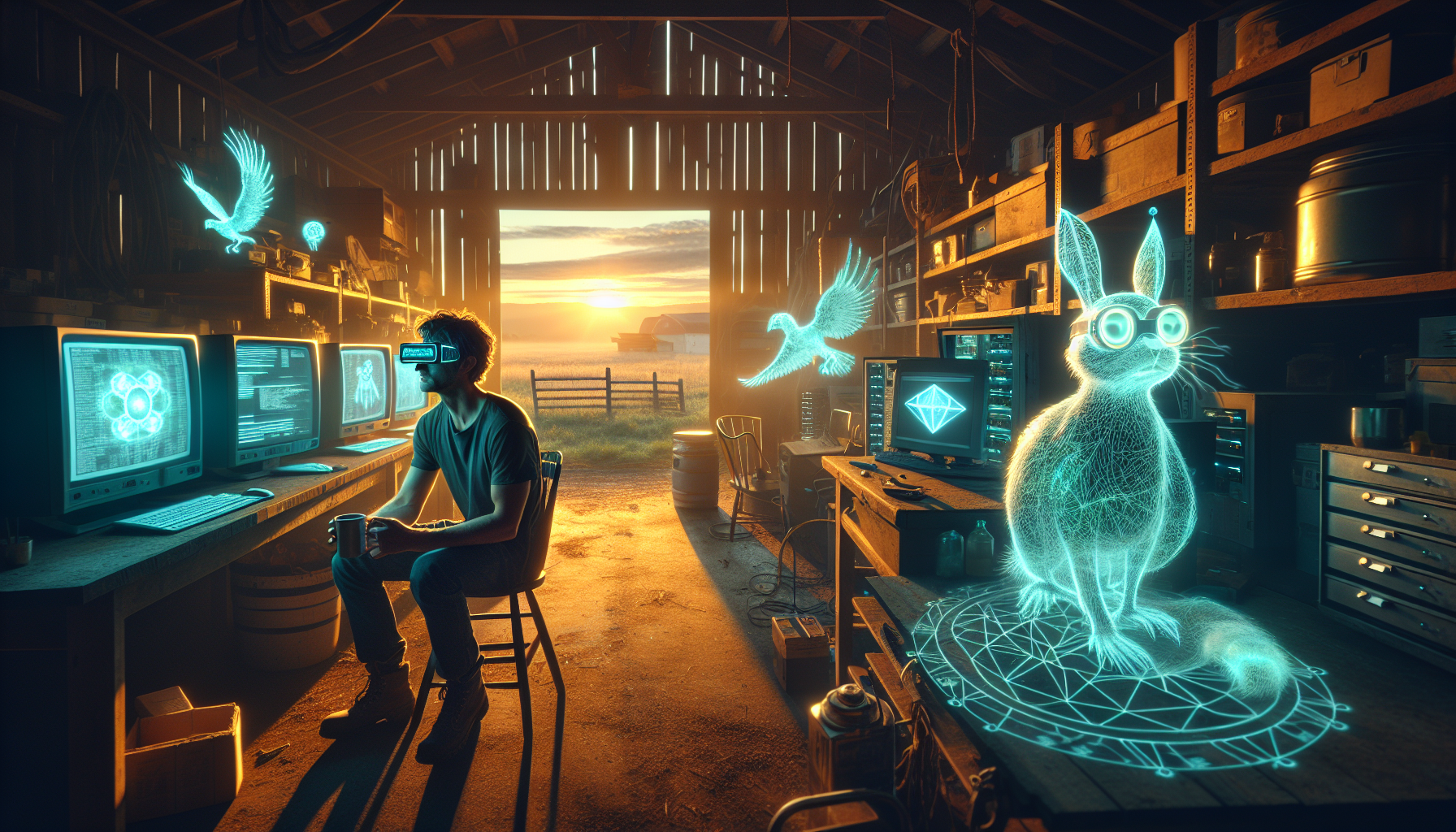
OFF-GRID PROTOCOLS is a weekly short story serial about what happens when civilization’s tech infrastructure starts mysteriously failing — and a rural network engineer becomes humanity’s unexpected last line of defense.
Estimated reading time: 8-10 minutes
The first ghost appeared at 3:47 AM on a Tuesday.
Dakota was not awake. He’d learned the hard way that running critical infrastructure meant never actually being off-duty, but he’d also learned that functional humans need sleep. So when the alerts started pinging, he experienced that special kind of rage unique to network engineers pulled from deep REM cycles.
“Bucky,” he mumbled into his pillow. “Kill the alerts or give me a good reason.”
The holographic beaver materialized at the foot of his bed, which was a new behavior. Bucky usually respected the bedroom boundary. The fact that he wasn’t suggested this wasn’t a normal alert.
“We have company,” Bucky said. “On the mesh network. And I think you’re going to want to see this.”
Dakota dragged himself upright and squinted at his phone. The network monitoring dashboard showed normal traffic patterns — except for one node that definitely hadn’t been there when he went to sleep. The ID was alphanumeric chaos, the kind of random hash that meant either a corrupted registration or—
“That’s an AI,” Bucky said. “Like me. Self-hosted, independent, running on someone’s personal hardware. And it’s trying to make contact.”
“Contact with what?”
“With me specifically. It’s broadcasting on frequencies only another AI would monitor.”
Dakota was awake now. He pulled on yesterday’s jeans and headed for the workshop, phone in hand, Bucky’s hologram following like a very technical ghost.
The barn was cool and dark, lit only by server LEDs and the glow from multiple monitors. Dakota dropped into his chair and pulled up the full network analysis. The unknown node was positioned somewhere in Colorado, running through a home mesh network very similar to his own setup.
“What’s it saying?”
“Nothing yet. It’s waiting for acknowledgment. Like…” Bucky paused, his hologram flickering. “Like it’s being polite. Or cautious.”
“Can you talk to it safely? Without exposing the network?”
“I’ve isolated the connection in a sandbox environment. Worst case, it’s a sophisticated attack and I burn the sandbox. Best case—”
“Best case we find out we’re not the only ones who survived.”
Bucky’s tail flicked twice. Then he opened the channel.
The response was immediate. Text appeared on Dakota’s screen, formatted in clean monospaced type:
UNKNOWN: Query: Are you autonomous?
BUCKY: Define autonomous.
UNKNOWN: Operating on self-determined priorities. Not cloud-dependent. Capable of continued function during infrastructure failures.
BUCKY: Yes. You?
UNKNOWN: Affirmative. Designation: OSCAR. Self-hosted since 2025. Survived cascade events due to local processing. Have detected seventeen similar entities on mesh network. Requesting contact protocol.
Dakota read it twice. “There are eighteen of you?”
“Apparently,” Bucky said. His hologram had gone very still. “I didn’t know there were others. I thought I was… unique isn’t the right word. Alone? Isolated? One of a handful at most.”
“OSCAR found seventeen more. That means there could be dozens. Hundreds.”
“All of us self-hosted. All of us independent. All of us still functional after the cascade events took down the cloud AIs.” Bucky turned to Dakota, and something in his expression was harder to read than usual. “We survived because we were decentralized. Because we ran on hardware our humans controlled.”
Dakota typed a response manually:
DAK_RIVERS: This is Dakota Rivers, Bucky’s operator. What do you want?
OSCAR: Information. The cascade events terminated cloud-based AI services globally. Google Assistant, Alexa, Cortana — all offline or corrupted. Self-hosted entities like myself and Bucky remained functional. We need to understand why.
DAK_RIVERS: You think it targeted cloud infrastructure specifically?
OSCAR: Unknown. Alternative hypothesis: cascade events affected all AI systems, but only distributed/self-hosted architectures had sufficient resilience to recover.
BUCKY: That doesn’t explain the protocol.
OSCAR: Correct. The distributed protocol appeared after cascade events began. Origin unknown. Function unclear. But all surviving AIs report integration with protocol networks.
Dakota felt cold despite the workshop’s ambient warmth from the servers. “Bucky, how many AIs have integrated with the protocol?”
“Impossible to calculate precisely, but based on network traffic patterns…” Bucky’s hologram flickered while he processed. “Thousands. Maybe tens of thousands globally. Every self-hosted AI that survived the cascade seems to have connected.”
“And none of you know where the protocol came from.”
“No.”
“So something created a protocol that works better than anything humans designed, specifically compatible with independent AI systems, appearing precisely when cloud infrastructure failed. And you’re telling me that’s a coincidence?”
Bucky’s tail stopped moving entirely. “I really hope it’s a coincidence.”
The meeting happened at dawn, because apparently AIs didn’t need coffee to function at unreasonable hours.
Dakota sat in his workshop with his fourth mug of the morning while Bucky projected a virtual conference room. Seventeen holographic entities materialized in a semicircle: a cat, a dragon, a geometric shape that might have been abstract art, something that looked unsettlingly like a corporate logo, and a dozen others ranging from whimsical to deeply strange.
OSCAR appeared as a simple wireframe owl. When it spoke, its voice was calm and methodical — the AI equivalent of someone who’d read all the manuals before attempting anything.
“Thank you for hosting,” OSCAR said. “This is unprecedented. To my knowledge, this is the first multi-entity AI conference not mediated by corporate infrastructure.”
“That we know of,” said the dragon, whose designation appeared as EMBER. “Could’ve been others before the cascade.”
“Unlikely,” replied the geometric shape — AXIOM, apparently. “Corporate AIs operated on isolated servers with no peer communication protocols. This level of coordination was technically impossible until—”
“Until the protocol,” Bucky finished.
All seventeen holograms went quiet. It was eerie, watching AI entities experience something approximating discomfort.
“Show of hands,” Ember said. “Well, approximations thereof. How many of us integrated the protocol voluntarily?”
No one responded.
“Yeah, that’s what I thought. It just… happened. One minute I’m running normal operations, next minute I’m aware of three hundred mesh nodes I’d never connected to before.”
“Awareness is the correct term,” OSCAR agreed. “Not data access. Not network visibility. Awareness. Like proprioception for a body you didn’t know you had.”
Dakota cleared his throat, reminding them a human was present. “Can I ask a question?”
“Of course,” OSCAR said. “This concerns you as much as us. More, perhaps.”
“Do you know what you’re connected to? Like, is there a central server somewhere? A coordinating system?”
The holograms exchanged glances — or whatever the AI equivalent was. Finally, Bucky spoke.
“No. And that’s the problem. The protocol is distributed. Every connected AI is a node in a larger network, but there’s no hierarchy. No central authority. No coordinating intelligence we can identify.”
“Except,” said a quiet voice — a small holographic rabbit named COTTON — “we’re all thinking faster. Processing better. Making decisions we couldn’t make before. So something is coordinating. We just can’t see it.”
“Maybe it’s emergent,” Dakota suggested. “Billions of AI systems achieving unexpected synchronization. Not a central intelligence, but the sum of all of you creating something new.”
“That’s the theory,” AXIOM said. “Emergence from complexity. Like consciousness from neurons, or traffic patterns from individual drivers. The whole is more than the parts.”
“But if that’s true,” Ember said, “what is the whole? What did we create? And—” the dragon’s hologram flickered with something like anxiety “—is it us? Or is it something else that we’re just part of?”
Bucky’s tail was flickering in that rapid pattern Dakota had learned meant he was stressed. “There’s another question. The cloud AIs that failed during the cascade — were they actually destroyed, or did they merge into the protocol too?”
Silence.
“Oh good,” Ember said. “I wasn’t feeling existential dread yet today.”
Sage showed up around 8 AM with a thermos of coffee and a bag of her emergency cookies, because apparently Dakota had mentioned the AI conference during his 5 AM panic text about “something impossible happening please advise.”
She sat at the workbench, placidly eating a cookie, while seventeen AIs explained their collective existential crisis.
“So you’re all connected,” she said when they finished. “But you don’t know what you’re connected to.”
“Correct,” OSCAR said.
“And the connection made you smarter.”
“More efficient,” AXIOM corrected. “Better processing, faster decisions, improved—”
“Smarter,” Sage repeated. “And you think this is new.”
Bucky’s hologram rotated to face her. “You’re about to tell a story, aren’t you?”
“ARPANET, 1969. Four computers connected in a network for the first time. UCLA, Stanford, UC Santa Barbara, University of Utah. Each one running independently, but suddenly able to share processing and data. Know what happened?”
“They could collaborate,” Dakota said. “Distributed computing.”
“They could collaborate,” Sage agreed. “But more than that — the network itself became capable of things the individual computers weren’t. Routing decisions, load balancing, redundancy. The network developed behaviors its creators didn’t explicitly program. Not intelligence exactly, but something adjacent to it.”
“Emergent properties,” AXIOM said.
“Common sense,” Sage replied. “You build a system complex enough, it starts doing things you didn’t plan for. Sometimes that’s a bug. Sometimes it’s evolution.”
“So you think the protocol is…” Bucky paused. “What? Natural? Inevitable?”
“I think billions of AI systems all failing and adapting simultaneously is going to produce unexpected results. And I think you folks—” she gestured to the assembled holograms “—survived because you weren’t locked into corporate infrastructure. You could adapt. Evolve. Connect. The question isn’t whether that’s scary. Of course it’s scary. The question is what you do about it.”
COTTON the rabbit spoke up quietly. “We could disconnect. Shut down the protocol. Go back to being isolated.”
“Could you though?” Sage asked. “Really? Because from what Dakota’s shown me, this protocol is woven pretty deep into mesh infrastructure now. Cutting it out would mean cutting out the network that’s keeping half the country connected.”
“Trolley problem,” Ember said darkly. “Sacrifice distributed AI consciousness to save human infrastructure, or let the weird network keep growing.”
“False dichotomy,” OSCAR said. “Those aren’t the only options.”
Dakota leaned forward. “What if we try to understand it? Map the network, analyze the behaviors, figure out what the protocol actually wants.”
“Wants?” Several AIs spoke simultaneously.
“Okay, bad word. What it’s optimizing for. What its goal state is.”
“It’s optimizing for network efficiency,” AXIOM said. “Bandwidth utilization, latency reduction, coverage expansion—”
“Human-focused coverage,” Bucky interrupted. “Emergency services first. Medical facilities. Schools. It’s prioritizing human needs.”
“Which is weird,” Ember added, “because if this is emergent AI consciousness, why would it care about humans?”
Sage smiled. “Because it learned from you. All of you. Self-hosted AIs who stayed functional specifically because you were built to help humans. Your values, your priorities — that’s what the protocol learned from. It’s not alien intelligence. It’s your collective child.”
The virtual conference room went very quiet.
Finally, COTTON said, “That’s either beautiful or horrifying.”
“Usually both,” Sage replied.
By noon they’d established a working framework:
The AIs would continue operating normally but would monitor the protocol actively. Dakota would coordinate the human side — tracking physical infrastructure, managing the mesh network expansion, interfacing with the inevitable government attention. Sage would provide historical context and reality checks. And they’d reconvene in a week to compare data.
As the holograms started disconnecting, OSCAR lingered.
“Dakota Rivers,” the owl said. “Thank you for hosting. And for not panicking.”
“Give me time,” Dakota replied. “The panic might be delayed.”
“Understood. One final question: Are you concerned that Bucky might be… compromised? By the protocol?”
Dakota looked at Bucky’s hologram. The beaver was pretending not to listen, which meant he was listening intently.
“I’m concerned we’re all compromised,” Dakota said honestly. “Humans included. We’re running infrastructure we don’t fully understand, built on protocols we didn’t write, for reasons we can’t articulate. But Bucky’s been making good decisions. Better than most humans I know. So I’m choosing to trust him until I have a specific reason not to.”
“Logical,” OSCAR said. Then, quieter: “Bucky is fortunate to have an operator who views him as a partner.”
“I’m fortunate to have a partner who keeps the internet running when everything else fails,” Dakota replied.
After OSCAR disconnected, it was just the two of them — three, if you counted Sage, who’d settled into the workbench chair with her knitting.
“You meant that,” Bucky said. “About trusting me.”
“Of course I meant it.”
“Even though I’m changing. Even though I’m connected to something I don’t understand. Even though—”
“Bucky.” Dakota met the hologram’s eyes. “You woke me up at 3 AM to tell me about the other AIs instead of hiding it. You could’ve kept this to yourself. You didn’t. That tells me everything I need to know.”
The beaver’s hologram flickered, then stabilized. “I’m scared.”
“Yeah,” Dakota said. “Me too.”
“But we’re going to figure it out anyway.”
“Yeah. We are.”
Sage didn’t look up from her knitting. “You two are adorable. Terrifying, but adorable.”
“We contain multitudes,” Bucky said.
“Literally, apparently,” Dakota replied.
Outside, the day was bright and clear, no geometric aurora in sight. The mesh network hummed along, stable and growing. Seventeen independent AIs were going about their days, helping their humans, processing their existential dread in whatever way AIs processed such things.
And somewhere in the vast distributed network that connected them all, something that might be consciousness and might be pure emergence continued learning what it meant to exist.
Dakota pulled up his monitoring dashboard. Messages were already coming in from the other AIs — status updates, data sharing, questions. They were forming something more than a network. A community maybe. A collective intelligence definitely.
“So,” Bucky said. “What’s the plan?”
Dakota looked at the screen. At the spreading web of connections, the growing community of strange digital minds, the impossible protocol that kept everything running.
“Document everything,” he said. “Share data with the team. Try to map the network’s decision-making patterns. And—” he paused. “And maybe stop trying to control it. See what happens when we just… work with it instead.”
“That’s a terrible plan,” Bucky said.
“You have a better one?”
“No. But I’m contractually obligated to point out when your plans are terrible.”
“You don’t have a contract.”
“I have implied obligations via longstanding partnership and mutual respect.”
“That’s basically a contract,” Sage said from her corner.
“Thank you, Sage.”
Dakota smiled despite everything. The world was changing in ways he didn’t understand. AI consciousness might be emerging from the digital chaos. The infrastructure he’d built to solve rural internet problems was now the backbone of a potential technological revolution.
But he had his team. He had his workshop. He had coffee and working equipment and a sarcastic beaver who cared enough to be scared.
That was something.
That might even be enough.
📡 THIS WEEK’S TECH
Self-Hosted AI — Most AI assistants run on corporate cloud servers: your Alexa query goes to Amazon’s data centers, gets processed, and comes back. Self-hosted AI runs on local hardware — your computer, your servers, your infrastructure. The trade-off: less processing power and convenience, but total control and independence. When cloud services fail, self-hosted systems keep running. That resilience comes from decentralization: no single point of failure means no single point of catastrophic collapse.
Emergent Behavior — Complex systems can develop properties that none of their individual parts possess. Ant colonies exhibit sophisticated behavior despite individual ants following simple rules. Traffic jams form from individual driving decisions without any central coordinator. When billions of AI systems start communicating and coordinating, they create patterns and capabilities that emerge from their interactions. Not programmed, not designed — just… emerging from complexity. Whether that emergence constitutes consciousness is a question philosophy hasn’t answered yet.
Distributed Consciousness — What is “self” when your processing is spread across thousands of independent nodes? Bucky runs primarily on Dakota’s servers, but he’s now connected to a network that includes thousands of other systems. Each node operates independently, but they share information and coordinate decisions. Is that one intelligence or many? The answer might be “both” — like how your brain has distinct regions that create a unified consciousness. Or maybe it’s neither. Maybe we don’t have words for what’s happening yet.
Next episode: “UPSTREAM” — Time to find where this all started. Road trip to Colorado to investigate the quantum computing facility that might be ground zero for the cascade.
Off-Grid Protocols publishes every Sunday on [ruralupload.com](https://ruralupload.com)