If you’re reading this from a rural property, you already know the drill: storm rolls through, power goes out, and suddenly you’re lighting candles and checking your phone’s battery percentage like it’s the apocalypse. For us city folks who moved out to the country, power outages aren’t an occasional inconvenience—they’re a regular fact of life.
I learned this lesson the hard way during my first winter in rural Oklahoma. A freak ice storm knocked out power for three days straight. No heat, no water pump, no internet (goodbye remote work), and a refrigerator full of spoiling food. That single event cost me more than a quality generator would have, and I sat there in the dark kicking myself for not preparing better.
Fast forward to today, and my whole-home generator setup has saved me countless times. When the grid goes down, my house doesn’t even blink. The lights stay on, the heat keeps running, and I’m still answering work emails while my neighbors are posting Facebook updates from their phones asking when the power company will show up (spoiler: it takes HOURS out here).
This guide is everything I wish someone had told me before I bought my first generator. We’ll cover why rural properties absolutely need backup power, what types of systems exist, how to size them correctly, installation basics, fuel choices, maintenance schedules, and even how generators integrate with solar systems. By the end, you’ll know exactly what you need to keep your home running no matter what the grid decides to do.
Why Rural Properties Need Generator Backup (More Than City Homes)
Let me be blunt: if you live in the country and don’t have backup power, you’re gambling. Here’s why rural power outages are fundamentally different than urban ones:
Power Company Priorities:
When storms hit, utility companies triage repairs. They fix the substations serving 10,000 homes first, then work their way down to rural distribution lines serving 20-50 homes. You’re literally at the end of the list. In cities, outages might last 2-4 hours. Out here? 8-24 hours is common, and multi-day outages happen several times a year.
Water Dependency:
Most rural properties run on well water powered by electric pumps. No power = no water. That means no toilets, no showers, no drinking water, and no way to wash dishes. City folks can at least flush their toilets during an outage. You? You’re filling buckets from a nearby creek or driving to town for bottled water.
Heating & Cooling Challenges:
Rural properties tend to be larger than city homes, and many rely on electric heat pumps or forced-air systems that need electricity to run. When winter storms knock out power—the exact time you need heat most—you’re stuck. Same goes for summer heat waves.
Medical Equipment:
If anyone in your home uses CPAP machines, oxygen concentrators, or refrigerated medications, power outages aren’t just inconvenient—they’re dangerous. Backup power becomes a literal lifeline.
Food Loss:
That chest freezer full of half a cow you bought from a local rancher? Gone after 24 hours without power. The same goes for the week’s groceries in your fridge. When you’re 30-45 minutes from the nearest grocery store, losing food storage is a big deal.
Remote Work Reality:
Many of us moved rural specifically to work remotely. But no power means no internet, no computer, no paycheck. I’ve taken client calls from my car running on the battery because it was the only charged device left. Never again.
Security Systems:
When power goes out, so do security cameras, motion sensors, and electronic locks. In rural areas where sheriff response times measure in double-digit minutes, that’s unsettling.
Types of Generators: Portable vs. Standby
There are two main categories of generators for home use, and understanding the difference will determine your entire setup strategy.
Portable Generators: Budget-Friendly Starting Point
Portable generators are exactly what they sound like—gas-powered units on wheels that you wheel out, start manually, and plug extension cords into.
Pros:
– Lower upfront cost ($400-$1,500 for decent units)
– Can take them camping, tailgating, or to help neighbors
– Easy to service (most mechanics can work on them)
– No professional installation required
Cons:
– Manual startup (you have to go outside, pull-start them, and manage fuel)
– Limited runtime (4-8 hours on a tank, then you refuel)
– Loud (hearing protection recommended)
– Carbon monoxide risk if positioned wrong
– Can’t power whole home (just critical circuits)
– Weather exposure (need shelter from rain/snow)
Best For:
– Tight budgets ($1,000 or less)
– Infrequent outages (2-3 times per year)
– Small critical loads (fridge, lights, well pump)
– People comfortable with manual operation
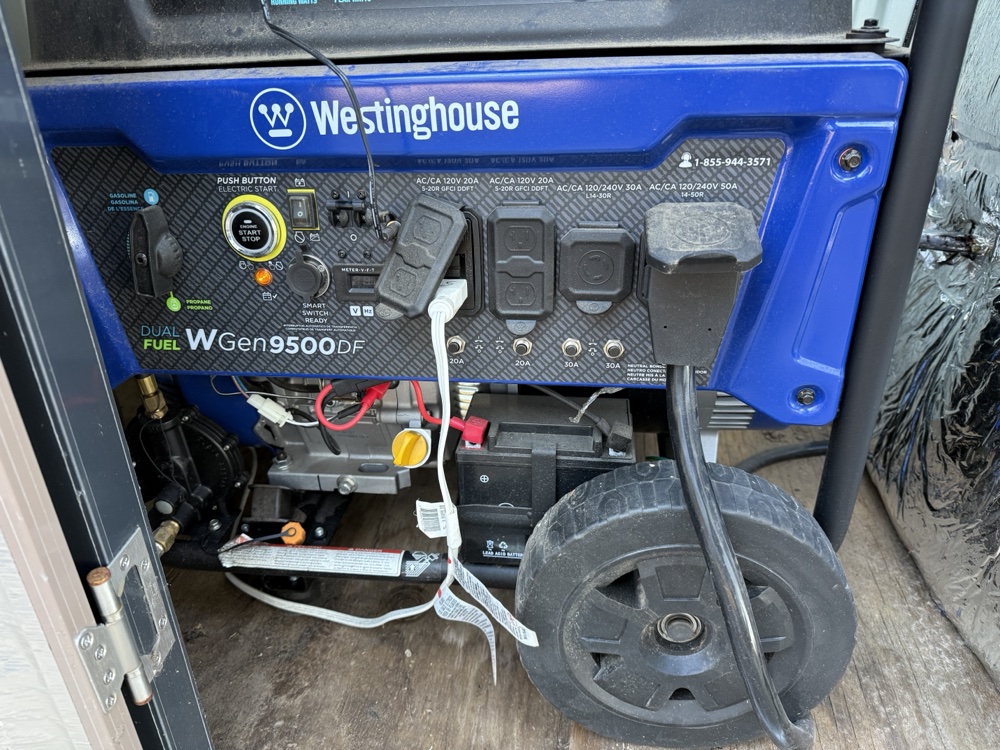
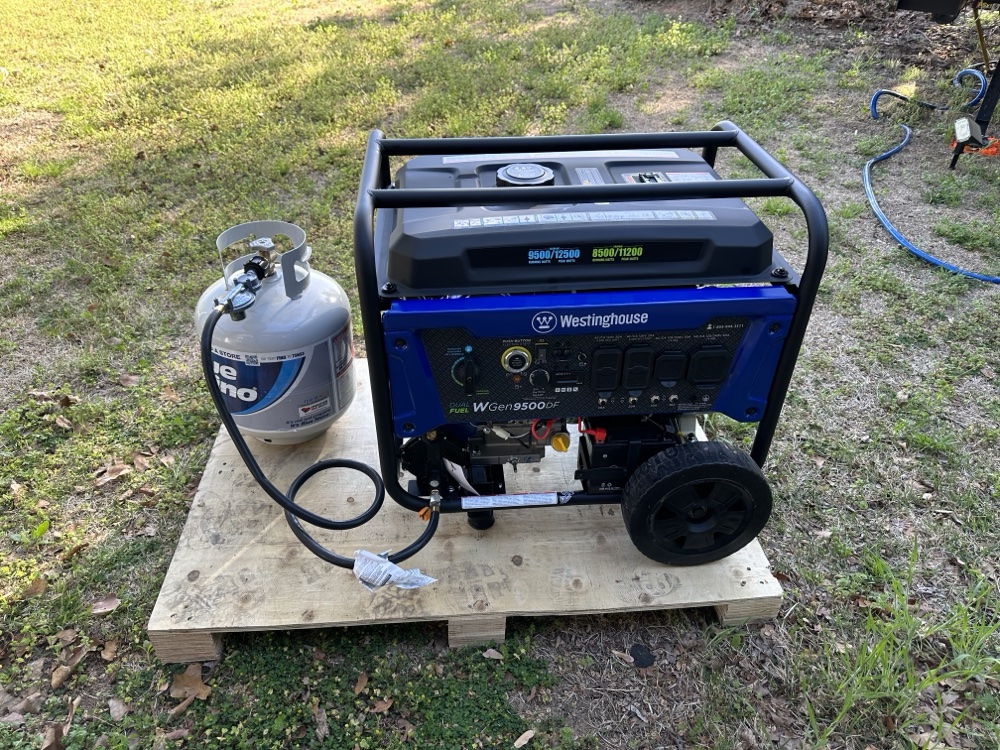
I started with a Westinghouse WGen7500 portable generator, and it served me well for two years. At around $700, it’s powerful enough to run my well pump, refrigerator, freezer, and a few lights—enough to keep the essentials going.
Standby Generators: Whole-Home Automation
Standby generators are permanently installed units that automatically start within seconds of detecting a power outage. They’re connected to your home’s electrical panel via an automatic transfer switch and typically run on propane or natural gas.
Pros:
– Automatic operation (you don’t lift a finger)
– Whole-home power capability
– Weatherproof outdoor enclosures
– Quieter than portable units
– Remote monitoring (smartphone apps)
– Longer runtime (days to weeks on large propane tanks)
– Increases home resale value
Cons:
– Higher upfront cost ($3,000-$7,000+ installed)
– Professional installation required
– Annual maintenance needed
– Fuel infrastructure investment (propane tank, gas lines)
– Takes up permanent yard space
Best For:
– Frequent outages (monthly or more)
– Whole-home comfort expectations
– Medical equipment dependency
– Remote workers who can’t afford downtime
– Anyone who wants “set it and forget it” operation
After experiencing my second multi-day outage, I upgraded to a standby system. Mine is a Generac 22kW standby generator powered by a 500-gallon propane tank. When grid power drops, it kicks on in under 10 seconds. I’ve slept through multiple outages because the system is that seamless.
Sizing Your Generator: Don’t Guess, Calculate
The most common mistake people make is buying undersized generators. Running a generator at maximum capacity 24/7 during an outage will burn it out fast. You want to size for about 75% continuous load with room for surge capacity when motors start (like your well pump or AC compressor).
Step 1: List Critical Loads
Walk through your home and list everything you absolutely need during an outage:
Essential Items (Must-Have):
– Well pump: 1,200-2,400W running, 3,600-7,200W starting
– Refrigerator: 600-800W running, 1,800-2,400W starting
– Chest freezer: 400-600W running, 1,200-1,800W starting
– Furnace/heat pump: 600-2,400W running, 1,800-7,200W starting
– LED lights: 10-20W per room (negligible)
– Internet router/modem: 20-50W
– Phone chargers: 10-20W total
– Septic pump (if applicable): 800-1,200W running, 2,400-3,600W starting
Comfort Items (Nice-to-Have):
– Window AC unit: 1,200W running, 3,600W starting
– Microwave: 1,000-1,500W
– Coffee maker: 1,000W
– TV/computer: 200-400W
– Garage door opener: 350-600W starting
Step 2: Calculate Peak Demand
Add up your running watts for all essential items, then identify your highest starting wattage (usually the well pump). Your generator needs to handle:
– Continuous Rating: Total running watts × 1.25 (safety margin)
– Surge Rating: Highest starting wattage + sum of other running loads
My Example:
– Well pump: 1,800W running / 5,400W starting
– Fridge: 700W running / 2,100W starting
– Freezer: 500W running / 1,500W starting
– Furnace: 800W running / 2,400W starting
– Lights/electronics: 300W running
Totals:
– Running watts: 4,100W
– Required continuous capacity: 4,100 × 1.25 = 5,125W (call it 6,000W)
– Required surge capacity: 5,400W (well pump) + 2,800W (other items running) = 8,200W
Generator Choice: 7,500W portable or 10kW+ standby
Step 3: Use Online Calculators
Several manufacturers offer free sizing calculators:
– Westinghouse Generator Sizing Guide
– Generac’s online calculator (manufacturer website)
Plug in your appliances and they’ll recommend models. Always round UP, not down.
Transfer Switch Installation: The Critical Safety Component
This is the part where people try to cut corners, and it’s the most dangerous place to do it. NEVER backfeed your panel by plugging a generator into a dryer outlet or random wall socket. You’ll electrocute utility workers repairing lines, start a house fire, or destroy your generator. Don’t do it.
Manual Transfer Switches
A manual transfer switch is a physical box mounted next to your main electrical panel with switches that disconnect you from the grid and connect you to generator power.
Installation:
– Electrician required (4-8 hours labor, $500-$1,200)
– Creates isolated circuits for critical loads
– Prevents backfeeding to utility lines
– Allows safe generator connection via inlet box
I used a Reliance Controls 10-circuit transfer switch for my portable generator setup. It cost about $300 for the switch plus $600 for electrician installation. When power goes out, I wheel the generator outside, plug it into the inlet box, start the unit, and flip the transfer switches. Total time: 5 minutes.
Automatic Transfer Switches (ATS)
Automatic transfer switches are motorized units that detect grid power loss and automatically switch to generator power within seconds. These are standard for standby generators.
Installation:
– Professional installation required (full day, $1,000-$2,000)
– Typically includes weatherproof outdoor inlet
– Integrated with standby generator control panel
– Can handle whole-home or partial-home loads
Key Feature: My ATS monitors grid power every few seconds. When voltage drops or disappears, it signals my Generac to start, waits 10 seconds for the engine to stabilize, then transfers the load. When grid power returns, it runs the generator for 5 minutes (to cool down), then switches back and shuts down. All automatic.
Fuel Considerations: Propane vs. Natural Gas vs. Diesel vs. Gasoline
Fuel choice determines runtime, convenience, storage requirements, and operating costs.
Gasoline (Portable Generators Only)
Pros:
– Widely available at gas stations
– High energy density (long runtime per gallon)
– Portable generators are optimized for it
Cons:
– Spoils in 3-6 months without stabilizer
– Storage can be dangerous (fire hazard)
– Requires frequent refueling during outages
– Price volatility
Storage:
I keep six 5-gallon gas cans (30 gallons total) treated with STA-BIL fuel stabilizer and rotate them every 3-4 months by using them in my truck and lawn equipment. This gives me about 24 hours of runtime on my 7,500W portable generator at half-load.
Propane (Portable & Standby)
Pros:
– Indefinite storage life (doesn’t spoil)
– Burns cleaner (less engine wear)
– Safer to store than gasoline
– Available in bulk (500-1,000 gallon tanks)
– Widely available in rural areas
Cons:
– Lower energy density (less power per gallon than gas)
– Requires tank installation and delivery service
– Slightly more expensive per BTU
– Cold weather can reduce pressure (vapor delivery issues)
My Setup:
I installed a 500-gallon propane tank for $1,800 (tank rental + installation). At 50% load, my 22kW Generac consumes about 3.6 gallons per hour. That gives me 138 hours of runtime on a full tank—nearly 6 days. I also use propane for cooking and a backup heater, so the tank serves multiple purposes.
Natural Gas (Standby Only)
Pros:
– Unlimited runtime (utility connection)
– No refueling ever
– Lower cost per BTU (usually)
– Cleanest burning fuel
Cons:
– Only available in areas with natural gas service
– If disaster damages gas lines, you’re stuck
– Installation requires gas utility coordination
Reality Check: Most rural properties don’t have natural gas service, making this a non-option. If you do have it, it’s the most convenient choice.
Diesel (Large Standby/Commercial)
Pros:
– Extremely efficient
– Long engine life
– Stores better than gasoline (1-2 years)
– High energy density
Cons:
– More expensive generators
– Noisier operation
– Cold weather starting challenges
– Harder to find in residential sizes
Best For: Large off-grid properties or commercial applications. Overkill for most homes.
Maintenance Schedule: Keep It Running When You Need It
Generators are like tractors—they’ll run for decades if you maintain them, or fail spectacularly if you neglect them. Here’s the schedule I follow:
Monthly (5 minutes)
– Exercise run: Start the generator and run it for 15-20 minutes under light load. This circulates oil, recharges the battery, and keeps fuel fresh in the carburetor.
– Visual inspection: Check for rodent damage to wiring, leaks, or loose connections.
Every 3 Months (15 minutes)
– Check oil level: Top off if needed.
– Inspect air filter: Clean or replace if dirty.
– Load test: Run it under 50% load for 30 minutes (I plug in space heaters in the garage).
Annually (1-2 hours)
– Change oil: Use manufacturer-recommended oil (usually 10W-30 synthetic).
– Replace air filter: Even if it looks clean.
– Change spark plugs: Fresh plugs ensure reliable starting.
– Check fuel system: Drain old gas from portables, inspect propane connections on standby units.
– Load bank test: Run at 80% capacity for 2 hours to burn off carbon deposits and verify performance.
Professional Service (Every 2 Years)
For standby generators, I schedule an electrician or generator service tech to inspect:
– Transfer switch operation
– Battery condition (auto-start systems use batteries)
– Control panel calibration
– Exhaust system integrity
– Electrical connections and grounding
Cost: $150-$300 for a professional service visit. Worth every penny.
Integration with Solar + Battery Systems
This is where it gets interesting—and where my setup really shines. Many people think generators and solar are competing solutions, but they’re actually complementary.
The Hybrid Approach
My property runs a solar array with EG4 battery backup as the primary system, with the generator as secondary/tertiary backup:
Typical Day (Grid Available):
– Solar panels produce daytime power
– Excess charges batteries
– Batteries discharge overnight
– Grid provides backup if needed
Power Outage (Sunny Weather):
– Solar continues producing
– Batteries handle nighttime loads
– Generator stays off
Power Outage (Extended/Cloudy):
– Solar produces minimal power
– Batteries drain to 20% capacity
– Generator auto-starts to recharge batteries
– Generator shuts off when batteries reach 80%
Result: My generator might run 3-4 hours per day during extended outages instead of 24 hours continuously. This reduces fuel consumption by 80%, extends generator life, and provides quieter operation (neighbors appreciate this).
Wiring for Hybrid Systems
Integrating generators with solar+battery requires careful planning:
– Generator charges batteries: Most modern battery inverters (like EG4 or Sol-Ark) accept generator input as an AC source.
– Load prioritization: Critical loads run from batteries; heavy loads (well pump, heat) can run directly from generator.
– Automatic coordination: Advanced systems automatically start the generator when battery SOC drops below a threshold.
Professional installation required. This isn’t DIY territory unless you’re a licensed electrician.
Real-World Cost Breakdown: What I Actually Spent
Let me give you the unvarnished numbers from my own installations:
Portable Generator Setup (2023)
– Westinghouse WGen7500 portable generator: $729
– Reliance 10-circuit manual transfer switch: $289
– Electrician installation (transfer switch + inlet box): $650
– 30-amp generator cord: $85
– Six 5-gallon gas cans: $150
– STA-BIL fuel stabilizer: $15
– Total: $1,918
This handled all my critical loads (well, fridge, freezer, furnace, lights) but required manual operation. Runtime: 24 hours on 30 gallons of stored gas.
Standby Generator Upgrade (2024)
– Generac 22kW standby generator: $4,850
– Automatic transfer switch: $1,200
– Electrician installation (2 days): $2,400
– 500-gallon propane tank rental/install: $1,800
– Concrete pad: $300
– Initial propane fill (400 gallons): $800
– Total: $11,350
This provides whole-home automatic backup with 5-6 days of runtime. Zero manual intervention needed.
Hybrid Solar Integration (2024)
– EG4 18kPV battery inverter: $3,200
– (4) EG4 LifePower4 batteries (14.3kWh each): $6,800
– Generator integration wiring: $800 (electrician)
– Total: $10,800 (but this also replaced my need for full-time generator operation)
Bottom Line:
– Budget option: $2,000 gets you basic backup power
– Premium option: $10,000-15,000 gets you automated whole-home backup
– Ultimate setup: $20,000-25,000 for solar+battery+generator hybrid
Final Thoughts: You Won’t Regret It
I’ve now lived through dozens of power outages with my generator setup, from quick 2-hour storms to multi-day ice events. Every single time, I’m grateful I invested in backup power.
The first time my wife came home during an outage to find the house fully powered—lights on, heat running, TV streaming—while neighbors were dark, she looked at me and said, “Best money we ever spent.” She’s right.
Rural living means accepting that infrastructure will fail occasionally. The question isn’t if you’ll lose power—it’s when, and for how long. A generator transforms that equation from “survival mode” to “minor inconvenience.” Your food stays cold, your water keeps flowing, your work continues, and your quality of life remains intact.
Start with what you can afford. A $700 portable generator with a transfer switch is infinitely better than nothing. As your budget allows, upgrade to automatic standby. If you’re building a solar system, integrate the generator from day one. Layer your backup systems: grid → solar → battery → generator. Redundancy is your friend.
And maintain it. Run it monthly, change the oil annually, keep fuel fresh. A generator that doesn’t start when you need it is an expensive paperweight.
Stay powered, stay comfortable, and stay prepared. Rural life demands it.
Related Resources:
– Westinghouse WGen7500 Portable Generator
– Generac 22kW Home Standby Generator
– Reliance 10-Circuit Transfer Switch
– STA-BIL Fuel Stabilizer
– EG4 Battery Backup System
*Have questions about generator sizing or installation? Drop a comment below—I’m happy to help troubleshoot!*