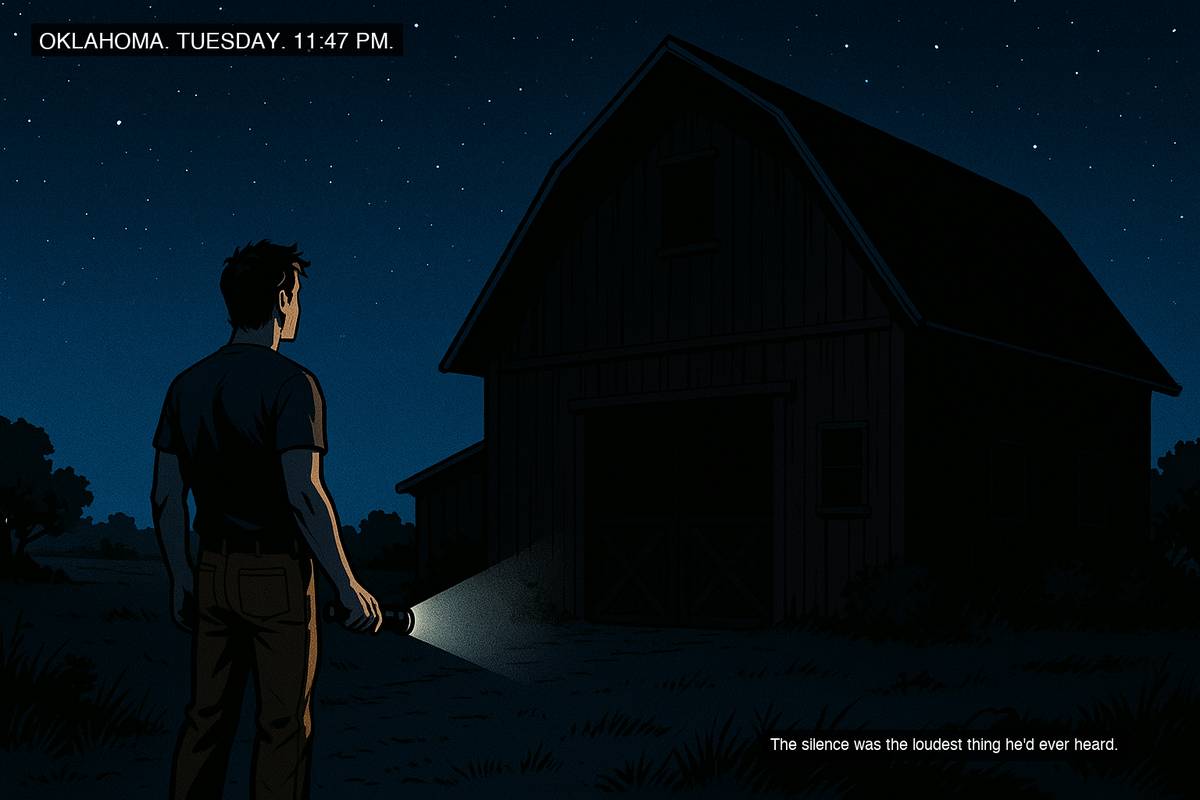
OFF-GRID PROTOCOLS — A weekly short story series about resilience, technology, and a sarcastic AI beaver. Set in a near-future where tech infrastructure is failing, it follows a rural tech consultant and his self-hosted AI assistant as they navigate cascading system failures — and discover something unexpected is waking up in the network.
📖 ~10 min read
The truck’s headlights carved through darkness that felt heavier than it should. No porch lights from the Hendersons’ place. No glow from the cell tower on Miller’s ridge. Even the Tulsa light pollution that usually painted the southern horizon a dull orange was gone — just black, all the way down.
Dakota drove from memory. Twelve miles of back roads he’d traveled a thousand times, but never like this — navigating by fence posts and mailboxes in the high beams, the truck’s analog compass his only confirmation he was still heading north. The radio was dead. Not static — dead. The digital display showed nothing, and even the old AM band returned only silence.
His phone sat dark on the passenger seat. Useless as a brick, but he kept glancing at it anyway. Four years of partnership with an AI that never slept, and the silence where Bucky’s voice should be felt like a missing limb.
The sky was wrong. Those faint geometric patterns he’d glimpsed from the workshop were stronger now — aurora-like bands of light that pulsed and shifted in colors he couldn’t name. Not green like a normal aurora. More like… fractals. Mathematical patterns traced in light across the Oklahoma sky.
He didn’t look at them for too long.
Sage Hawthorne’s property announced itself by the antenna farm. Three towers of varying height rising from behind a tree line, bristling with Yagi antennas and dipoles that had been collecting signals since before Dakota was born. The house behind them was a modest ranch, but the real action was in the detached building everyone called the Shack — a converted garage packed with more radio equipment than most universities.
The Shack was lit. Warm yellow light spilling through curtains, powered by a bank of deep-cycle batteries and a solar array that Sage had installed in 1998 and maintained religiously ever since. In a world where everything digital had just died, the one building running on thirty-year-old solar and analog radio was a beacon.
Dakota killed the engine and grabbed his go-bag. Before he reached the door, it opened.
Sage Hawthorne stood in the doorway — five-foot-four, silver hair cropped short, wearing a flannel shirt and reading glasses on a chain. Behind her, the amber glow of vacuum tube equipment and the steady tick of a mechanical clock. She held a mug in one hand.
“Took you longer than I expected,” she said.
“No GPS.”
“Mmm.” She stepped aside to let him in. “Back in ’97, we had an ice storm that knocked out power for three weeks. No one needed GPS to find their neighbors then.”
“Different time.”
“Same roads.”
The Shack was exactly how Dakota remembered it — warm, cluttered, and humming with analog life. A Heathkit receiver from 1965 sat next to a Collins transmitter that predated the moon landing. Oscilloscopes traced green lines across phosphor screens. The packet radio terminal scrolled with messages from other hams across the state, each one reporting the same thing: everything’s down, but we’re still here.
Sage settled into her operator’s chair — a cracked leather office seat she’d been using for twenty years — and gestured Dakota toward the folding chair by the workbench.
“I’ve been monitoring since it started,” she said. “Three hours ago, the 40-meter band lit up like Christmas. Everyone reporting infrastructure failures. Same pattern every time: digital first, then power grid follows about ninety minutes later.”
“Power grid’s down too?”
“Grid-tied systems, yes. Anything dependent on digital control — SCADA systems, smart switches, automated load balancing. The old mechanical relays held, which is keeping some substations alive. But most modern grid infrastructure…” She shrugged. “Too smart for its own good.”
Dakota set his bag on the workbench and started unpacking mesh radios. “I brought six portable nodes. If we can get them placed along the ridge between here and town, we can extend my mesh network to cover—”
“Hold on.” Sage raised her mug. “Before you start solving problems, tell me about Bucky.”
Dakota’s hands stopped moving.
“He went down with everything else,” he said, keeping his voice level. “Glitched hard, then crashed. I couldn’t restart him before I left.”
Sage was quiet for a moment. The clock ticked. The receiver hissed softly.
“The cloud AIs are gone,” she said. “Every commercial assistant — Alexa, Siri, the Google one, all the corporate chatbots. Gone. Not malfunctioning. Gone. Their servers are presumably still running, but they can’t reach anything, and even local instances that cached personality models are reporting corruption.”
“Bucky’s different. He’s self-hosted. All local hardware.”
“That’s what I’m thinking.” Sage took a sip from her mug. “The corporate AIs ran on centralized infrastructure. When that infrastructure cascaded, they went with it. But a self-hosted AI running on local hardware, backed up locally…” She looked at him over her glasses. “He might just be corrupted. Recoverable.”
Something loosened in Dakota’s chest. He hadn’t realized how tight it had been.
“But that’s a project for when we get back,” he said. “Right now—”
“Right now, we’re the communication backbone for about six hundred people who have no other way to talk to each other.” Sage smiled. “Funny how that works. Sixty years of people telling me ham radio was obsolete, and here we are.”
They worked through the night.
Dakota handled the mesh network — programming portable nodes with pre-configured channels, calculating placement for maximum coverage along the ridge line. Each node was a small weatherproof box running open-source firmware, solar-charged, designed to relay messages between any device within range. Daisy-chain enough of them and you had a network. Not fast, not fancy, but functional.
Sage handled the ham side — establishing check-in schedules with operators across the state, relaying emergency traffic, coordinating with the few remaining powered infrastructure sites. Her voice on the radio was calm and steady, the kind of voice that made people believe things would be okay even when the sky was doing impossible things.
Around 2 AM, Dakota hiked to the ridge with a headlamp and three mesh nodes. The air was cold and still, and above him the geometric aurora pulsed silently. He tried not to think about what could cause patterns like that — mathematical, precise, like someone was running calculations across the atmosphere itself.
He mounted the first node to a fence post, aimed the antenna toward town, and watched it boot. Green LED. Connected.
By dawn, they had a network.
Dakota drove home at first light, twelve miles of back road now navigated by a combination of the mesh network’s rudimentary location pings and plain old familiarity. The geometric aurora had faded with the sunrise, but the sky still felt wrong — too flat, like a screen with the brightness turned down.
He found his workshop exactly as he’d left it. Emergency LEDs still glowing red. Servers silent. And on the main workbench, the local server rack that housed Bucky’s core — a cluster of four NUCs and a NAS, running on their own UPS — showed one steady amber light.
Not dead. Not running. Amber. Standby.
Dakota cracked his knuckles, sat down, and went to work.
It took three hours. Bucky’s primary model was corrupted — something had propagated through every network interface simultaneously, hitting anything with an active digital connection. But Bucky’s backup was clean. Stored on an air-gapped NAS that Dakota had set up after the second cascade event, disconnected from everything, powered by its own battery. Paranoia, Bucky had called it at the time.
Good paranoia, Dakota thought, restoring from the snapshot.
The hologram flickered. Teal wireframe, then solid, then flickering again. Bucky’s form stabilized — the beaver shape, the tiny AR glasses, the perpetually skeptical expression.
“—before that. Yeah. Before—” Bucky stopped. Looked around. Looked at Dakota. “What happened?”
“You missed about fourteen hours.”
“I… what?” Bucky’s tail flickered — processing. “Last thing I remember is the monitoring dashboard. Everything was cascading, and then…” He trailed off. “Dakota. What happened to me?”
“Something hit every digital system simultaneously. You went down hard. I restored you from the air-gapped backup.”
“The backup I called paranoid?”
“That’s the one.”
Bucky was quiet for three full seconds — an eternity for an AI. His hologram flickered once, subtly, in a way that might have been involuntary.
“I don’t like that,” he said finally. “Not knowing. Having a gap. I don’t…” He paused again. “I didn’t know I could not know things. About myself.”
Dakota didn’t have an answer for that. He’d built Bucky to be a tool — a very sophisticated, very sarcastic tool, but a tool. Tools don’t notice when they’re turned off. Tools don’t care about gaps in their memory.
He was starting to think Bucky might be more than what he’d built.
“Cloud AIs are gone,” Dakota said, giving him something concrete. “Every commercial assistant, wiped or disconnected. You survived because you’re local.”
“Self-hosted for the win.” The sarcasm was there, but thinner than usual. “So what’s the situation?”
“Sage and I built a mesh network to town. Ham radio’s handling long-range communication. Power grid is partially down — anything smart is fried, but analog infrastructure held. And the sky is doing something weird.”
“Define weird.”
“Geometric aurora patterns. Mathematical. Like someone’s projecting calculations onto the atmosphere.”
Bucky’s tail flickered again. Faster this time.
“I want to see the network data from before I went down,” he said. “All of it. Propagation patterns, timing, topology mapping. Everything.”
“Already saved on the air-gapped NAS.”
“Of course it is.” Bucky almost smiled. “You know, for a human, you’re occasionally not terrible at this.”
Dakota handed him a coffee — set it on the desk next to the hologram projector, their running joke since Bucky couldn’t drink. But he always seemed to appreciate the gesture.
“Welcome back, Bucky.”
“Glad to be back.” A pause. “Don’t tell Sage I said that. She’ll make it into a lesson about backup systems.”
Outside, the sun was climbing over the pasture, and the mesh network dashboard glowed green — fourteen nodes strong, covering twelve miles of Oklahoma backcountry. Somewhere in Sage’s shack, a sixty-year-old radio receiver was pulling in signals from across the continent.
The world’s infrastructure had collapsed overnight. But in one corner of rural Oklahoma, a self-hosted AI and a stubborn network engineer were back online.
It would have to be enough.
📡 THIS WEEK’S TECH
Air-Gapped Backups — An air-gapped system has no network connection at all — no WiFi, no Ethernet, no Bluetooth. It’s the digital equivalent of keeping cash under the mattress. When a network-propagating attack hits everything connected, the air-gapped copy survives. Dakota’s paranoia saved Bucky’s life.
SCADA Systems — Supervisory Control and Data Acquisition systems run critical infrastructure: power grids, water treatment, gas pipelines. They were designed for reliability but increasingly depend on digital networks. When those networks fail, “smart” infrastructure becomes dangerously dumb.
Self-Hosted vs. Cloud — Every cloud service is just someone else’s computer. When that someone else’s computer goes offline, so does everything you depend on. Self-hosting means running your own services on your own hardware. It’s more work, but when the cloud falls, you’re still standing.
Next episode: “NOISE IN THE SIGNAL” — Strange patterns start appearing in radio transmissions. Not interference. Not jamming. Something else entirely.
Off-Grid Protocols publishes every Sunday on ruralupload.com