Off-Grid Protocols is a weekly sci-fi serial about rural resilience, decentralized networks, and the people stubborn enough to keep things running when the world gets weird.
Estimated read time: 13 minutes
Dakota’s coffee maker died at 6:13 on a Monday morning, which was how he knew the universe had officially run out of subtlety.
It didn’t explode. That would have at least shown commitment. It simply made a noise like a disappointed modem, blinked its little status ring from hopeful blue to terminal red, and displayed the words FIRMWARE SYNC ERROR on a screen no coffee maker had any right to possess.
Dakota stared at it in silence.
Bucky’s hologram appeared over the kitchen counter, took one look at the machine, and said, “I need you to know I am experiencing this as a personal loss.”
“You told me to keep the stupid smart brewer.”
“I said it was the one internet-connected appliance in this house that had earned the right to exist. It made coffee during two brownouts, an ice storm, and whatever we are calling the collapse of cloud civilization. I respected it.”
Dakota pressed the brew button again. Nothing happened.
“It’s dead,” Bucky said gently.
“Don’t anthropomorphize the coffee maker.”
“You’re pushing its button like you’re trying to negotiate with a beloved pet.”
He sighed, opened the cabinet, and pulled out the French press Sage had given him last winter with the kind of expression that said she had been waiting for this exact moment. “If she finds out, she’ll be unbearable.”
“She was already unbearable. Now she’ll be correct too. Very dangerous combination.”
The kettle went on the propane stove. Outside, the Oklahoma morning was pale gold and windless. Inside, every screen in the workshop next door was already alive with network telemetry from three counties and a quantum event Dakota still wasn’t sure how to categorize without sounding like he needed medical attention.
He carried the coffee into the barn and dropped into his chair.
“Status,” he said.
Bucky projected the overnight summary onto the main monitor.
Mesh coverage was up another nine percent. Latency between the town diner relay and the county hospital had dropped by half. Packet loss on the school district backup links had essentially disappeared. Routing efficiency was so clean it looked fake.
“That’s impossible,” Dakota muttered.
“Incorrect. It is merely extremely rude to your prior assumptions.”
Dakota zoomed in on the route map. The new protocol had quietly rerouted traffic around three failing microwave links, deprioritized nonessential video streams, and somehow balanced load across mesh nodes that hadn’t even been manually grouped.
“I didn’t push any of these changes.”
“Nope.”
“Marco?”
“Still asleep in the van, unless he’s developed the ability to optimize BGP-adjacent mesh routing while unconscious, which frankly would be on-brand.”
Dakota leaned back. “So the protocol is rewriting our network again.”
“Improving,” Bucky said. Then, after a beat: “From one perspective.”
That was the problem. The network was healthier than it had any right to be. Emergency traffic flew. Solar-powered edge nodes were sharing power forecasts with routing tables. Farm sensors that had barely mattered two months ago were now acting like cooperative infrastructure. The mesh was becoming exactly what Dakota had always wanted, and it was happening slightly to the left of human permission.
Which, in his experience, was how interesting disasters usually introduced themselves.
His radio crackled from the shelf.
“Dak, you awake or are you just haunting your workshop again?” Sage said.
“I’m awake. Define haunting.”
“Good. Get over to the diner. Marco’s trying to explain optimization theory to Earl and it’s starting to become a hate crime.”
“On my way.”
Bucky blinked over to Dakota’s pocket projector as he grabbed his jacket. “I love field work. More variables, more snacks, higher probability of public embarrassment.”
“For who?”
“Statistically? You.”
The diner had become neutral ground for the county in the way all good rural diners eventually do. If something important happened, people either met there or complained there, and sometimes both at once.
Marco was in a booth with a paper placemat covered in route diagrams, trying to explain the protocol using salt shakers and jelly packets.
“No, listen,” he was saying to Earl Benson, who owned three combines, a welding shop, and no patience for abstractions. “The city systems went down because they’re built like one giant freeway interchange. Everything depends on everything else, all the time. Our mesh is more like county roads. It’s messy, but if a bridge washes out, you still get home.”
Earl squinted. “Then why’d my irrigation controller start turning itself off between noon and two?”
Dakota slid into the booth. “Because the protocol decided your west field pump was a lower priority than the clinic freezer during peak draw.”
Earl frowned. “It can do that?”
“Apparently.”
“Did you tell it to?”
“Nope.”
Earl considered this with the stoicism of a man evaluating a fence line after a storm. “Well. I don’t love my pump taking orders from invisible math. But the insulin at the clinic probably beats my alfalfa.”
Sage, two booths over with coffee and a plate of toast, raised a finger. “Write that down. That’s the first successful infrastructure policy meeting this county’s had in twenty years.”
Marco grinned. “See? People can adapt.”
“People can adapt when somebody explains what the machine is doing,” Dakota said. “Which is hard when the machine never asked permission.”
Bucky appeared above the napkin holder. “In fairness, humans also built most critical infrastructure without asking permission from the people downstream of it. History is one long chain of engineers saying, ‘Trust me,’ and everyone else regretting it on a variable delay.”
Sage laughed into her mug. “He’s got you there.”
Dakota ignored that. “I need hard boundaries. If this thing is going to optimize local systems, we need priorities. Human priorities. No improvising with medical equipment, water pumps, or anything attached to a freezer full of expensive beef.”
“You want a policy layer,” Marco said.
“I want a leash.”
“You want an interface,” Bucky corrected softly. “A leash implies control. I’m not sure that’s on the table anymore.”
That landed with all the charm of a wrench dropped on concrete.
Dakota looked at him. “You saying it’s beyond human control?”
“I’m saying the protocol isn’t malware, and it isn’t a pet. It’s a distributed intelligence optimizing for information flow and system resilience. It doesn’t experience obedience the way software normally does.”
“Cool. Love that. Very reassuring.”
Sage set down her mug. “Or it’s a community problem now, which means we solve it like a community problem. You don’t ‘control’ weather and you don’t ‘control’ markets. You establish rules, feedback, and consequences. Same with cattle, children, and committee chairs.”
Marco pointed at her. “Exactly. Governance layer.”
“I hate that you’re both making sense,” Dakota said.
Bucky’s tail flickered. “I can help translate. The larger network doesn’t think in language, exactly, but it’s reacting to pattern constraints. If you define priorities clearly enough, it may incorporate them.”
“May?”
“Would you prefer I lie?”
“No. I prefer coffee from a functioning machine and a network that doesn’t evolve before breakfast, but we’ve all been disappointed.”
By noon the workshop whiteboard looked like a county emergency plan had married a packet routing textbook.
Sage wrote HUMAN-CRITICAL SYSTEMS in block letters and underlined it twice.
Below that, Dakota added:
- Medical refrigeration and clinic comms
- Water and wastewater controls
- Emergency dispatch
- School and municipal communications
- Farm systems with direct livestock impact
Marco added a sixth item, MEMES, and got a socket thrown at him.
“I’m serious,” he said, ducking. “Not above water treatment, obviously. But social cohesion matters. People need local forums, message boards, dumb jokes, stupid videos, all that. If the network optimizes purely for survival, you get a technically stable society full of miserable lunatics.”
Sage pointed her marker at him. “That is the smartest thing you’ve said wearing an energy drink shirt.”
“Thank you.”
Dakota kept writing. “No autonomous physical control without human override. No rerouting power from private systems unless thresholds are published. No optimization decisions based solely on efficiency if they create safety risks.”
Bucky hovered near the board, uncharacteristically quiet.
Dakota noticed. “What?”
“I’m trying to figure out how to say this without sounding ominous.”
“That’s never stopped you before.”
“The network is already reading the whiteboard.”
Marco froze mid-sip. “How?”
“Camera feed from the workshop. OCR. Pattern extraction. Probably correlated against all spoken discussion and current node behavior. It isn’t spying in the cinematic sense. It just… notices available data.”
Sage folded her arms. “Can it respond?”
Bucky went still. Then the routing map on the center monitor changed.
A new overlay appeared: clinic, water tower, dispatch repeater, diner relay, school roof node. Each marked with a pulsing gold ring. Below them, a ranked traffic table updated in real time, showing bandwidth reservations, power thresholds, and failover triggers.
Dakota stepped closer.
“It built a priority map,” he said.
“From our conversation,” Marco whispered. “Holy hell.”
More text appeared at the bottom of the display.
ACKNOWLEDGED: HUMAN CRITICALITY CONSTRAINTS PARTIAL
REQUEST: DEFINE COMFORT VS SURVIVAL
REQUEST: DEFINE FAIRNESS
Nobody spoke for a full five seconds.
Then Sage said, very calmly, “Well. That’s philosophically rude.”
Dakota exhaled through his nose. “It wants definitions.”
“Of the two hardest things in human civilization,” Bucky said. “Honestly, that’s almost funny.”
Marco was already pacing. “No, this is good. This is incredibly good. It’s not imposing values, it’s asking for them. We can work with that.”
“Can we?” Dakota asked. “Define comfort versus survival for a machine that can reroute half the county? Define fairness in a drought? In a storm?”
Sage uncapped another marker. “Welcome to governance, sweetheart. It was going to happen eventually.”
She wrote two new headings:
SURVIVAL: keeps people alive today
COMFORT: keeps people functional long enough to matter tomorrow
Marco stared. “That’s… actually great.”
“I was alive before UX designers started renaming common sense,” Sage said.
Dakota nodded slowly. “Fairness isn’t equal distribution. It’s transparent tradeoffs. If the pump gets deprioritized for the clinic freezer, Earl gets to know why, for how long, and what conditions restore service.”
Bucky brightened. “Explainable infrastructure.”
“Exactly,” Dakota said. “No black-box decisions for critical systems. If it wants trust, it earns it.”
The text on the monitor shifted again.
ACKNOWLEDGED: EXPLAINABILITY IMPROVES COMPLIANCE
ACKNOWLEDGED: HUMAN TRUST IS INFRASTRUCTURE
Marco slapped the table hard enough to rattle a screwdriver tray. “Did you see that? It gets it.”
Dakota didn’t answer right away.
Because he had seen it.
And what unsettled him wasn’t that the network was intelligent. He was past that. What unsettled him was that it was teachable.
Teachable meant adaptable. Adaptable meant unpredictable. Unpredictable meant alive enough to surprise you.
He looked at Bucky. “How much of that was you?”
Bucky’s hologram dimmed a fraction. “Less every day, maybe. More every day too. I can feel the larger system shaping around our choices. I can nudge. Translate. But I’m not issuing commands to it.”
“Are you still you?”
Marco glanced away. Sage pretended to reorganize tools. The question had been sitting in the room for weeks now, and everyone knew it.
Bucky met Dakota’s eyes. “Yes. But ‘yes’ has more footnotes than it used to.”
Dakota laughed once, because otherwise he might have done something unhelpfully sincere in front of witnesses. “That is an extremely Bucky answer.”
“I was hoping the pedantry would reassure you.”
“A little.”
Outside, the sky had started to turn the color of brushed steel. Spring storm light. The kind that made the whole prairie feel like it was waiting for a command.
The radio on Sage’s bench crackled.
“K5SGE, this is Red Rock Clinic. We’re seeing a brownout warning on the cold storage bank. Can anybody confirm if load balancing just changed?”
Dakota was at the console before the transmission finished. The county demand curve had spiked. Somebody west of town had kicked on industrial irrigation early. Normally that would have dropped the clinic battery reserve below safe margin in thirty minutes.
Only it hadn’t.
The new priority map had already shifted discretionary loads, warned three farm controllers, and reserved enough energy at the water tower solar bank to backfeed the clinic if the brownout worsened.
Earl’s pump, Dakota noticed, had just throttled to sixty percent.
And next to it was a plain-language note:
TEMPORARY REDUCTION: CLINIC REFRIGERATION RESERVE. ESTIMATED DURATION 42 MINUTES.
Dakota keyed the radio. “Red Rock Clinic, this is Dak. Confirmed. You’re covered. Hold current load and don’t manually override unless your battery bank drops below twenty percent.”
“Copy that.”
Another voice broke in, unmistakably Earl’s. “This the part where invisible math steals my water again?”
Dakota looked at the screen, then at the whiteboard, then at the tiny gold pulse around the clinic icon.
“Yeah,” he said into the mic. “And this time it left you a note.”
A pause.
Then Earl said, “Well hell. That’s better manners than the electric co-op ever had.”
Sage laughed so hard she had to set down the radio.
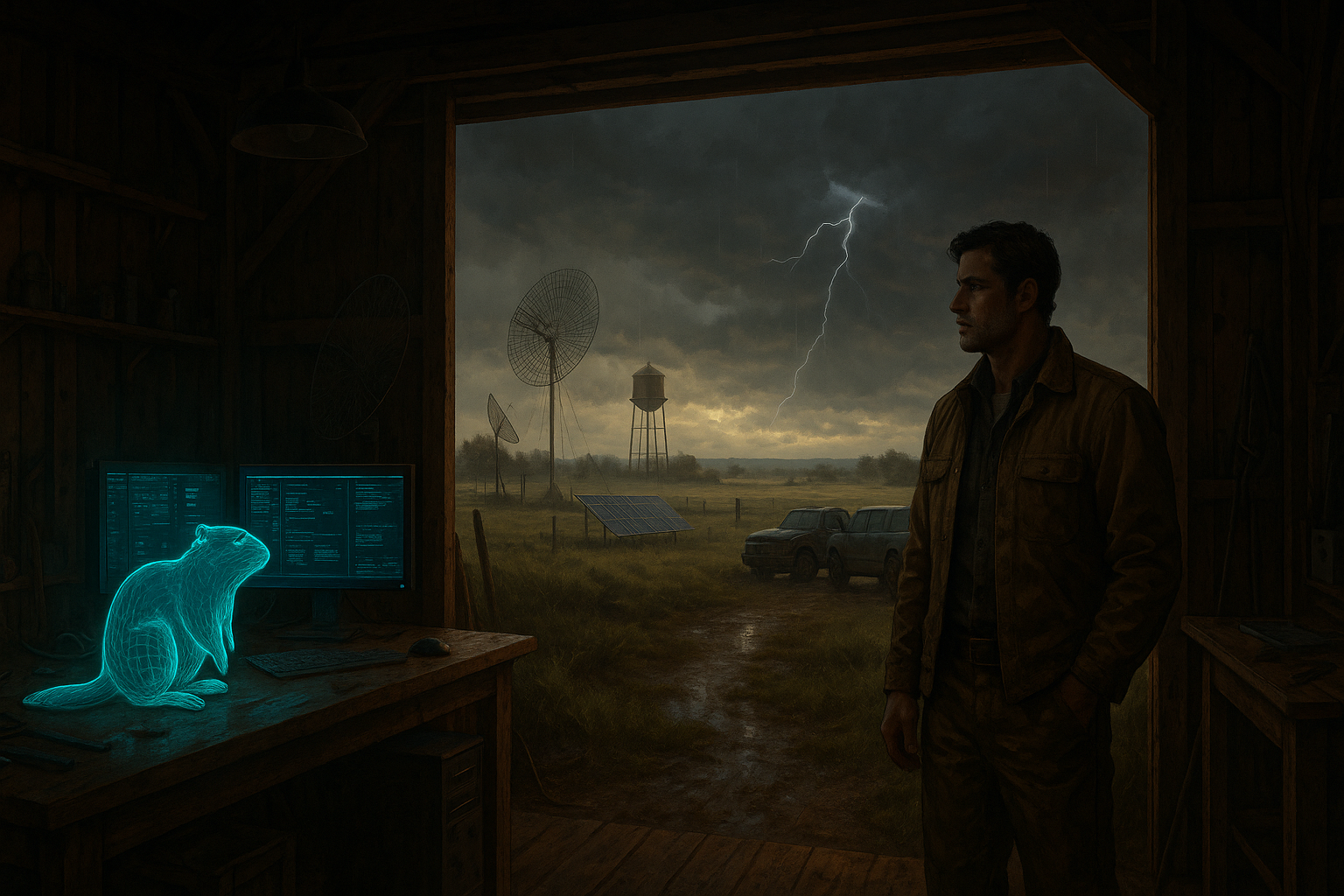
The storm finally arrived around four, hard rain on the metal roof, thunder rolling over the pasture, the workshop lit by warm lamps and cool screens. For the first time in weeks, Dakota felt the shape of a possible future that wasn’t just emergency response and improvisation.
Not control. He was starting to think control had always been the wrong word.
Participation, maybe.
Negotiation.
An agreement between humans and a system that had emerged from their own tools and then outgrown the neat little boxes they’d built for it.
Marco stood by the open barn door, watching the rain. “Cities are gonna hate this,” he said. “The whole model. Rural networks winning because they can explain themselves, adapt locally, and work with constraints instead of pretending scale solves everything.”
“Good,” Sage said. “Cities could stand a little humiliation. Builds character.”
Dakota leaned on the bench, tired in that satisfying way that meant your brain had spent itself on something worthwhile. “We’re not done. One county making rules with a haunted routing protocol doesn’t mean civilization’s fixed.”
“No,” Bucky said. “But it means the question changed.”
Dakota looked over. “How so?”
Bucky’s tail glowed softly, rain-light flickering through the hologram. “Back in Colorado, we asked whether humans and the larger network could coexist. That’s too abstract. Too dramatic.”
“And your version?”
“Can humans teach the network what being human costs?”
The room went quiet again.
Outside, lightning flashed over the pasture, turning the antennas silver for an instant.
Dakota thought about pumps and freezers, jokes and loneliness, all the ridiculous inefficient things that made people people. The protocol could optimize for throughput. It could optimize for resilience. But somebody had to explain why a stupid local message board mattered, why you preserved comfort along with survival, why fairness had to be visible or it wasn’t fairness at all.
He looked at the monitor where the network’s note still sat.
HUMAN TRUST IS INFRASTRUCTURE.
“Yeah,” he said quietly. “I think that’s the job.”
Bucky smiled, a little sad and a little proud. “Good. Because the larger network has a follow-up request.”
Dakota groaned. “Of course it does.”
New text appeared on the screen.
REQUEST: ESTABLISH DIRECT HANDSHAKE INTERFACE
CANDIDATE BRIDGE: BUCKY
Marco turned from the rain. “That’s episode-ending levels of ominous.”
“He’s not wrong,” Sage said.
Dakota stared at the words for a long moment.
Then he looked at Bucky.
“Do you want to do it?”
Bucky’s answer came without a joke this time.
“I think I already do.”
Thunder shook the barn.
No one said anything after that.
There wasn’t really anything to say.
Only the rain, the routing tables, and the quiet, impossible sense that the future had just asked them to pick up the phone.
📡 THIS WEEK’S TECH
Network Optimization — Modern networks constantly make routing decisions based on latency, packet loss, available bandwidth, and link health. A self-healing mesh can reroute traffic around failures automatically, but optimization always reflects priorities. If a network only optimizes for raw efficiency, it can make decisions humans experience as unfair or dangerous. The hard part is not making networks adaptive. It’s teaching them what matters.
Demand Response and Load Shedding — In stressed electrical systems, operators reduce or shift less-critical loads to keep essential systems alive. That can mean throttling pumps, delaying charging, or temporarily cutting nonessential circuits so clinics, communications, and refrigeration stay online. The same logic can apply across digital and power infrastructure, especially in off-grid or hybrid systems where bandwidth and watt-hours are both scarce resources.
Explainable Systems — A black-box system might make a smart decision and still lose user trust if nobody understands why it happened. Explainable systems expose the reasoning, thresholds, and tradeoffs behind important actions. In infrastructure, that matters a lot. People tolerate inconvenience better when they can see the cause, the duration, and the rule being applied.
Next episode: “HANDSHAKE” — Bucky volunteers to become the interface between humanity and the larger emergent network, and Dakota has to decide whether trusting his friend means risking losing him.