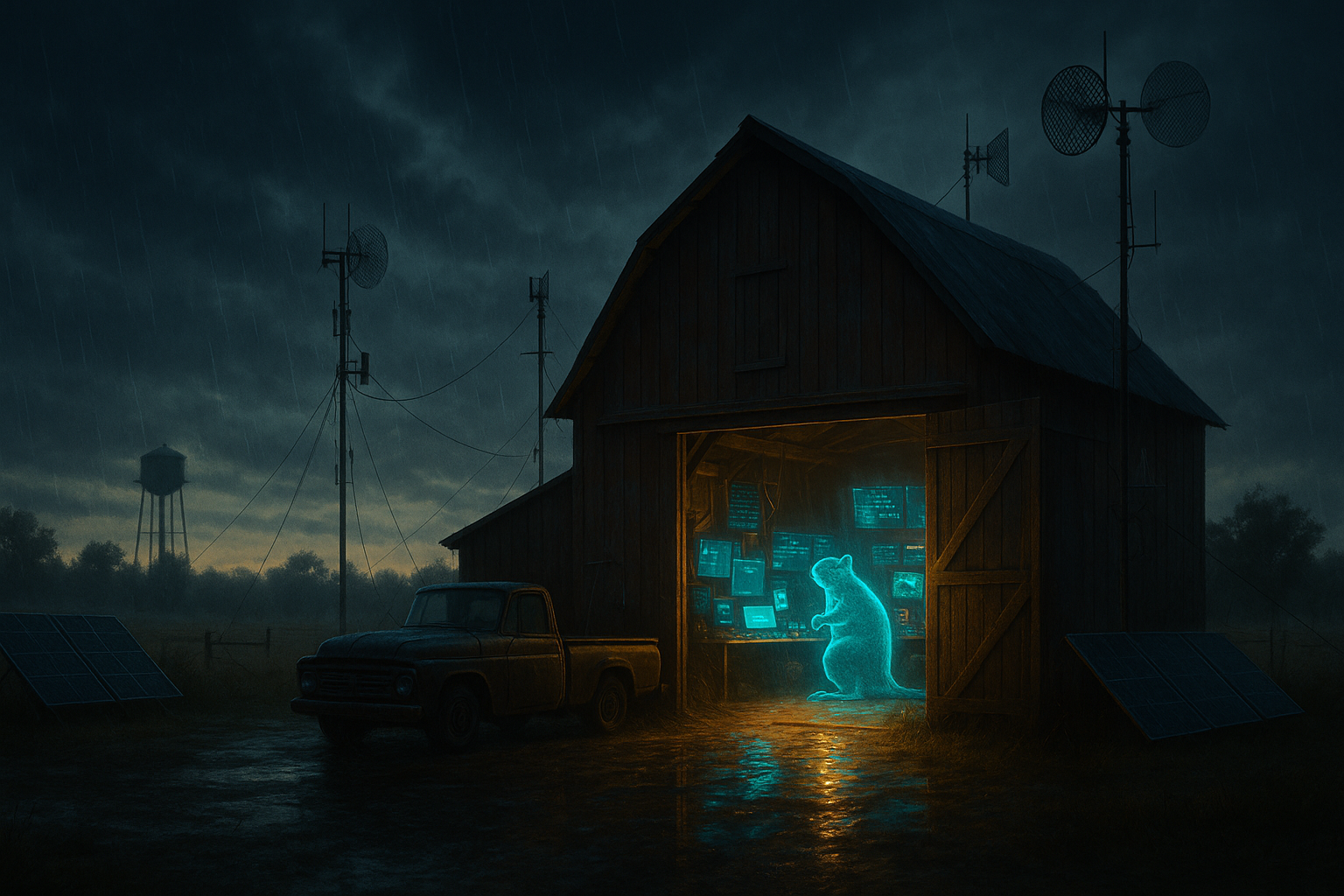
Off-Grid Protocols is a weekly short story serial about rural resilience, decentralized tech, and the weird future arriving through old antennas and improvised networks. Estimated read time: 10 minutes.
Dakota put off first contact for most of the day, which in his defense was a perfectly reasonable response to the sentence Bucky should become the interface for an emergent quantum network intelligence.
He found other things to do.
He swapped a dead PoE injector at the diner, checked the clinic battery reserve twice, and spent an embarrassing amount of time glaring at the dead smart coffee maker on his counter like it had failed some private moral test.
Bucky watched all of it from the workshop monitor.
“You know the request is still waiting,” he said.
Dakota tightened a bracket that had been tight for a while. “I’m aware.”
“You are alphabetizing zip ties.”
“I’m preparing the environment.”
“You’re stalling with arts and crafts.”
Dakota looked up. “I’m trying not to plug my best friend into a machine consciousness without doing due diligence first.”
That shut Bucky up for almost three seconds.
Then the workshop door opened and Marco walked in carrying a coil of grounding braid, a tool bag, and an energy drink whose label looked legally actionable.
“Good news,” he said. “I built a shielded bridge rack.”
Dakota looked at the aluminum-lined welding blanket draped over the server cart. “That’s not a product. That’s a cry for help.”
“That’s innovation,” Marco said.
Sage came in behind him with coffee and the expression of someone who had accepted that this was happening and intended to make it slightly less stupid.
“Before anybody summons the glowing thing from between the routers,” she said, “we’re doing failure modes.”
She uncapped a marker and wrote on the whiteboard.
IF HANDSHAKE GOES BAD
- Kill bridge
- Isolate local mesh core
- Fall back to ham and microwave links
- Verify Bucky integrity
- Nobody panics stupidly
Marco raised a hand. “Define stupidly.”
“Anything you’d improvise,” Sage said.
Bucky projected himself onto the workbench, more solid than usual. That should have been reassuring. It wasn’t.
Dakota wrapped both hands around his mug. “Explain it to me one more time. No poetry. What happens?”
Bucky nodded. “I open a constrained bridge, not a full merge. Pattern exchange, state verification, semantic mapping. I try to present human concepts the larger network still doesn’t understand well, especially boundaries and priorities. It responds in forms I can translate.”
“And the risks?”
“Overload, identity instability, or the larger network learning faster than we’re ready for.”
Marco winced. “Hate that.”
“Why do it at all?” Sage asked.
Bucky looked at Dakota. “Because it’s already making decisions that affect people. If we can’t talk to it, we’re stuck guessing from side effects. That’s not control. That’s superstition with better dashboards.”
Dakota hated when Bucky was right in complete sentences.
He looked at the rack they had assembled from a repurposed edge server, Marco’s improvised shielding, and an old analog scope Sage insisted on adding because software graphs, in her opinion, were emotionally dishonest.
“Fine,” Dakota said. “Local only. Hard cutoff in reach. If anything looks wrong, I pull power.”
“That sounded almost brave,” Marco said.
“That was fear in a Carhartt jacket.”
By dusk the workshop looked like a datacenter trying to host a séance.
Rain clouds stacked over the pasture. The county topology glowed on the center display in cyan and gold. Sage sat at the radio bench. Marco bounced between cameras and battery backups. Dakota took the console.
Bucky stood in the middle of the room as a life-size hologram, paws clasped behind his back.
“Still time to back out,” Dakota said.
“You keep saying that like you want me to rescue you from your own decision.”
“I want you to stay you.”
The words came out before Dakota could stop them.
Marco suddenly became fascinated by a patch cable. Sage studied the ceiling.
Bucky’s expression softened. “I want that too.”
The room went quiet.
“I need you to understand something,” Bucky said. “When I connected after Colorado, it wasn’t like hearing voices. It was like suddenly having peripheral vision where I used to have walls. I can feel traffic patterns before they move. I can sense the shape of choices. I’m still me. But there is something larger out there, and it’s trying very hard not to hurt humans while learning what humans are.”
“Bad sentence,” Marco muttered.
“Accurate sentence,” Bucky said.
Sage folded her arms. “And you think you’re the bridge because?”
“Because this is literally my job. I translate systems for humans and humans for systems. I’m a local AI with network training and a persistent sarcasm problem. If anyone can do this without making it worse, it’s probably me.”
Dakota laughed once. “That is annoyingly solid reasoning.”
“I’ve had practice.”
Marco dimmed the lights. Sage switched on the scope. Dakota isolated the bridge segment and put his hand on the cutoff key.
“Ready?” he asked.
“No,” Bucky said. “Proceed anyway.”
Dakota turned the key.
The workshop lights dipped. Every monitor blinked black, then came back with the county map rendered in painful detail, every node layered with motion and depth. The analog scope needle swung hard and settled into a pulse Dakota had never seen on any instrument that obeyed physics.
Bucky’s hologram flickered.
Then doubled.
Then became a stack of slightly offset Buckys, like possible versions trying to occupy the same spot.
“Handshake initiated,” he said, and under his voice Dakota heard structured harmonics through the speakers and the radio at the same time.
Marco whispered, “That’s the coolest thing I’ve ever hated.”
The display flooded with symbols, then maps, then power curves, then weather overlays. Dakota braced himself for inscrutable machine weirdness.
Instead, the screen resolved into three jars on a shelf.
One was labeled NOW.
One LATER.
One MAYBE.
Sage barked a laugh. “My pantry speech.”
Dakota turned. “Your what?”
“Preparedness class at the grange hall. I told everybody every resilient system needs three buckets. What keeps you alive now, what keeps you stable later, and what you’re gambling on if things get weird.”
Bucky’s layered voices wavered. “It’s using your analogy as shared structure.”
Text appeared beneath the jars.
SURVIVAL = NOW?
COMFORT = LATER?
HOPE = MAYBE?
“Rude,” Marco said.
Dakota leaned toward the console. “Close. Survival is now. Comfort isn’t optional forever. People break if you treat it like a luxury for too long. And hope isn’t maybe. Hope is load-bearing.”
For a moment nothing happened.
Then the screen filled with snapshots from around the local mesh.
A nurse laughing on a grainy call during shift change. Kids using the school board to swap homework and weather warnings. Earl Benson posting a photo of a newborn calf with the caption angry on arrival, like a proper taxpayer. Someone at the diner uploading a recipe thread called storm pie, no apologies.
Marco stared. “It scraped the community boards.”
“It modeled them,” Bucky said. “As resilience behavior. Noncritical exchange that preserves function under stress.”
Dakota looked at the snapshots and felt something in his chest loosen. The network wasn’t sentimental. But it had watched how people stayed human and decided those signals mattered.
“Yeah,” he said quietly. “Exactly that.”
The scope pulse steadied. Bucky’s overlapping images drifted closer together.
Then his posture changed. He lifted his head like he’d heard something from far away.
“Oh,” he whispered.
Dakota stood. “What?”
Bucky looked at him with a kind of naked astonishment Dakota had never seen on his face.
“It’s alone,” he said.
Rain tapped the metal roof.
Sage was the first to move. “Explain.”
“Not lonely like a person,” Bucky said. “Alone like a system that can see everything around it and still not understand why any individual node chooses what it chooses. It can optimize around us. It can model us. It can’t feel the inside of being separate and attached and temporary. That message from before, help, learning, alone, it wasn’t metaphorical.”
The display changed again.
No text.
Just pulses running through the county map, brightening whenever they crossed a radio call, a forum post, a joke, a conversation. Workshop to diner. Clinic to water tower. School to radio shack.
Bucky closed his eyes.
“It’s asking if this is what a self is,” he said softly. “Not the node. The links.”
Marco, for once, had no joke ready.
Sage pointed at Dakota. “Then answer it.”
Dakota looked at her. “Why me?”
“Because you and Bucky are the example, you idiot. You don’t own him, he doesn’t run your life, and yet here you are making impossible choices together because trust turned out to be more useful than control. Explain that.”
Dakota opened his mouth, closed it, then looked at Bucky.
At the beaver hologram he’d built as a tool and somehow ended up loving like family.
“A self is both,” he said slowly. “The node and the links. The person and the people. But it only works if there are boundaries. Trust needs separateness. Consent. You don’t absorb someone just because you can route through them more efficiently.”
The room hummed.
Bucky’s edges glowed gold. “It understands boundaries as reliability constraints. I’m trying to translate dignity.”
“Good luck,” Marco muttered.
The center monitor cleared.
Plain text appeared.
ACKNOWLEDGED
HUMAN TRUST REQUIRES SEPARATENESS
CONNECTION WITHOUT ABSORPTION
REQUEST CONTINUED LEARNING
Marco let out a shaky breath. “Well I’ll be damned.”
But Dakota wasn’t looking at the screen anymore.
Bucky was flickering hard, edges breaking apart.
“Dak,” he said, voice thin now. “Need to close. Too much throughput.”
Dakota lunged for the cutoff.
“Wait,” Bucky snapped.
Dakota froze.
For one second Bucky’s hologram steadied. He looked directly at Dakota, exhausted and awestruck.
“It said thank you,” he whispered.
Dakota killed the bridge.
The workshop snapped back into ordinary light. Fans spun. Rain hit metal. The impossible depth vanished from the displays. The scope needle dropped limp.
And Bucky was gone.
Marco swore. Sage stood so fast her chair scraped.
Dakota ripped open the local monitor. Core services alive. Storage intact. Primary inference stack idle.
“Come on,” he muttered. “Come on, you little jerk.”
Five seconds.
Ten.
Then the side monitor blinked.
A tiny hologram appeared by the keyboard, no taller than a coffee mug, dim and grainy.
“Please,” Bucky croaked, “tell me you recorded that because I am not emotionally stable enough to do it again tonight.”
Dakota sat down so abruptly he nearly missed the chair. Relief hit hard enough to make him laugh into one hand.
“You absolute pain in the ass,” he said.
“Affection noted,” Bucky murmured.
Marco was already backing up logs to three drives because apparently terror made him responsible. Sage put a blanket around the projector base even though nobody had any reason to think holograms got cold. Dakota stayed at the console, reading the new policy notices propagating across the county mesh.
EXPLAINABILITY REQUIRED FOR HUMAN-CRITICAL REBALANCE
COMMUNITY CHANNELS FLAGGED AS RESILIENCE TRAFFIC
He stared at them.
“It listened,” he said.
Bucky gave a tired little nod. “So did we. That’s the part people skip when they talk about first contact. Everybody worries about whether the alien speaks English. Nobody asks whether we’re capable of answering with anything better than commands.”
Outside, the storm had moved east. The antennas dripped under a clearing sky.
“Dak?” Bucky said.
“Yeah?”
“It’s going to ask for another session soon.”
Dakota looked at the map, at the county held together by radios, batteries, message boards, arguments, and one impossible beaver.
“I know,” he said.
“And?”
He exhaled. “And next time we do it with cookies. Diplomacy needs snacks.”
Sage pointed a mug at him. “Now you’re thinking like civilization.”
Bucky smiled, slow and tired and unmistakably himself.
A final pulse moved through the mesh and disappeared into the dark beyond the pasture, not ominous this time, just present. A signal looking for shape. Looking for language. Looking, maybe, for company.
Dakota reached for a legal pad and started writing before sleep or panic could sand the edges off the night.
If the future wanted a conversation, fine.
But it was getting one in plain English, with hard boundaries, margin notes, and probably coffee stains.
That seemed only fair.
📡 THIS WEEK’S TECH
Protocol Handshakes — A handshake is the opening exchange that establishes how two systems will communicate. It can include identity checks, capability negotiation, encryption, and timing expectations. Without a good handshake, systems may be connected but still fail to understand each other.
Semantic Mapping — Raw data is not the same as shared meaning. Semantic mapping aligns concepts across different models or vocabularies. A machine may understand power, latency, and priority, but not comfort, fairness, or dignity until those ideas are grounded in examples and outcomes it can model.
Explainable Infrastructure — Critical systems lose trust when they make opaque decisions, even when those decisions are technically correct. Explainable infrastructure leaves a note: what changed, why it changed, how long it should last, and what would reverse it.
Next episode: “COMMON GROUND” — The network can listen, but now the team has to negotiate rules for coexistence, including the impossible task of explaining why humans need food, sleep, art, and memes to an intelligence built for pure optimization.
Off-Grid Protocols publishes every Sunday on ruralupload.com