If you live on a rural property, you already know the frustration: cell service drops out, WiFi doesn’t reach the barn, and when severe weather rolls through, you need a way to communicate that doesn’t depend on infrastructure that just went down.
GMRS — General Mobile Radio Service — fills that gap. It’s more powerful than the walkie-talkies you used as a kid, easier to set up than ham radio, and with a simple repeater, you can cover an entire rural community. Here’s how to get started.
What Is GMRS and Why Should You Care?
GMRS is an FCC-licensed radio service that operates on UHF frequencies around 462 and 467 MHz. Unlike FRS (the cheap walkie-talkies at Walmart), GMRS lets you run up to 50 watts of power and use repeaters, which dramatically extends your range.
The license costs $35 for 10 years and covers your entire immediate family. No test required — just fill out the application on the FCC website and you’re legal within days. Compare that to ham radio, which requires passing an exam and doesn’t allow business or family use the same way.
For rural property owners, GMRS hits a sweet spot: enough power and range to be genuinely useful, simple enough that everyone in the family can use it, and affordable enough that you can put radios everywhere they’re needed.
Range: What to Actually Expect
You’ll see manufacturers claim 30 or 40 miles of range. In reality, here’s what you’ll get:
Handheld to handheld on flat terrain with stock antennas: 1 to 3 miles. In hilly or wooded areas, cut that in half. Still enough for property-wide communication on most spreads.
Handheld to mobile/base station with an external antenna: 5 to 15 miles depending on terrain and antenna height. This is the practical sweet spot for most rural users.
Through a repeater on a hilltop or tower: 15 to 40+ miles. This is where GMRS really shines. A well-placed repeater can cover an entire county.
The key factors are antenna height, terrain, and power. A 5-watt handheld with a stubby antenna will never match a 50-watt base station with an antenna on a tower — but that handheld in your truck will reach the base station at home just fine.
Getting Your License
Head to the FCC Universal Licensing System and apply for a GMRS license. The process takes about 10 minutes online:
1. Create an FCC Registration Number (FRN) if you don’t have one
2. Apply for a new GMRS license
3. Pay the $35 fee
4. Wait a few business days for processing
Your license covers you, your spouse, your children, and your parents — anyone in your immediate family can use your callsign. That’s a huge advantage over ham radio, where every individual needs their own license.
Choosing Your First Radios
Best Handheld for Most People
A good GMRS handheld runs about $30 to $80 and gives you a radio you can clip to your belt, keep in the truck, or hand to a family member. Look for one with at least 5 watts on GMRS channels, a removable antenna (so you can upgrade later), and weather alert capability.
The Radioddity GM-30 is a solid all-around choice. It’s affordable, easy to program, and puts out enough power for reliable communication across a typical rural property.
Best Mobile/Base Station
For a permanent installation in your house or truck, a mobile radio gives you more power (up to 50 watts) and better audio quality. Mount one in the kitchen, one in the truck, and you’ve got reliable communication for daily use.
Repeater for Extended Coverage
If you want to cover a large area or connect multiple properties, a GMRS repeater is the way to go. Mount it high — on a tower, a tall building, or a hilltop — and suddenly everyone within 15 to 40 miles can talk to each other through it.
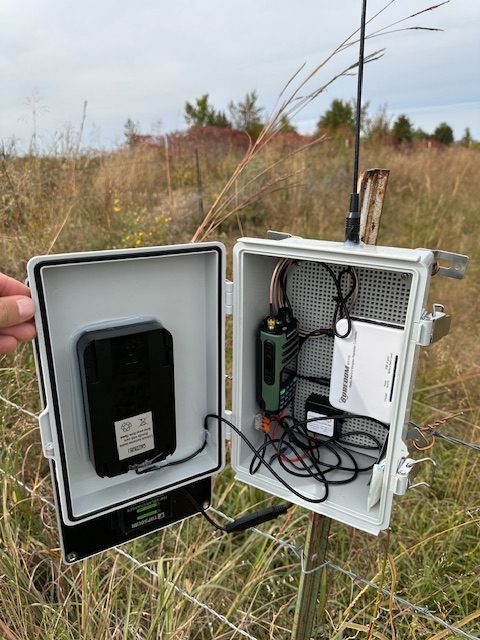
A solar-powered repeater is especially attractive for rural installations where running power to a hilltop isn’t practical. Pair a small solar panel, a battery, and the repeater in a weatherproof enclosure, and you’ve got an off-grid communication hub that runs indefinitely.
Setting Up a Property-Wide System
Here’s a practical setup for a typical rural property:
Base station in the house: A mobile radio with an external antenna mounted on the roof. This is your communication hub — always on, always listening. Connect it to a 12V power supply or run it from your solar battery bank.
Handhelds for the family: One for each person who works outside regularly. Keep them charged and on the same channel as the base station.
Mobile in the truck: A second mobile radio hardwired to your vehicle’s electrical system with a magnetic-mount antenna on the roof. Better range than a handheld while you’re driving around the property or heading to town.
Repeater for extended range: If your property is hilly or you want to connect with neighbors, put a repeater on your highest point. Even a modest 20-foot pole with a good antenna can make a dramatic difference in coverage.
GMRS vs. Other Options
GMRS vs. FRS: FRS is limited to 2 watts and non-removable antennas. GMRS gives you up to 50 watts and repeater access. FRS is fine for the kids playing in the yard; GMRS is what you need for real communication.
GMRS vs. Ham Radio: Ham gives you more frequencies, modes, and longer range, but requires a license exam, can’t be used for business, and has a steeper learning curve. GMRS is simpler, family-friendly, and practical for everyday property communication.
GMRS vs. Meshtastic: Meshtastic is text-only mesh networking — great for data, GPS tracking, and silent communication. GMRS gives you voice, which is faster and easier in emergencies. Many rural folks use both: GMRS for voice, Meshtastic for text and telemetry.
GMRS vs. CB Radio: CB is unlicensed but crowded, noisy, and limited to 4 watts AM. GMRS is cleaner, more powerful, and FM gives you better audio quality. CB still has its place in trucking, but GMRS is the better choice for property and community use.
Antennas Make the Difference
The stock antenna on your handheld is a compromise — it’s short and convenient but doesn’t perform well. For fixed installations, an external antenna is the single biggest upgrade you can make.
For a base station, mount a high-gain GMRS antenna as high as you reasonably can. Every 10 feet of height roughly doubles your effective range in flat terrain. A 20-foot pole on your roof puts your antenna at 30+ feet, which makes a huge difference compared to the stubby antenna on the radio sitting on your kitchen counter.
For vehicles, a magnetic-mount antenna on the roof works surprisingly well. The metal roof acts as a ground plane and the antenna sits higher than anything you’d clip to your belt.
Programming Tips
Most GMRS radios come pre-programmed with the standard GMRS channels (1 through 22). For a property setup, pick one channel as your “family channel” and leave all radios monitoring it.
If you’re using a repeater, you’ll need to program the repeater’s input and output frequencies. GMRS repeater pairs are on channels 15R through 22R, using a 5 MHz offset. Most modern radios handle this automatically — just select the repeater channel.
Consider adding NOAA weather channels to your scan list. Most GMRS radios can monitor weather frequencies even while listening on your main channel. In rural areas, severe weather alerts over the radio can be a lifesaver when your phone has no signal.
Legal Considerations
A few rules to keep in mind:
You need a license ($35/10 years, no test). Operating without one risks FCC fines, though enforcement on GMRS is rare for casual users.
Maximum power is 50 watts on most channels, 5 watts on channels shared with FRS (channels 8-14), and 50 watts on repeater output channels.
You can use GMRS for personal and business communication on your property. You can’t use it for broadcasting (one-to-many entertainment), but coordinating ranch work, calling the kids for dinner, or checking on livestock is perfectly fine.
Your callsign should be announced at the beginning and end of transmissions, or every 15 minutes during long conversations. In practice, most people announce it periodically and nobody gets in trouble.
Emergency Preparedness
GMRS is a natural fit for emergency communication. When cell towers go down during ice storms, tornadoes, or extended power outages, your GMRS radios keep working as long as they have battery.
Keep a plan: designated emergency channel, charged batteries or a solar charging setup, and make sure everyone in the family knows how to use the radios. A simple laminated card next to each radio with the channel assignments and basic instructions goes a long way.
If your community has a GMRS repeater, learn the local channel and introduce yourself. In an emergency, that repeater network could be the only way to call for help or coordinate with neighbors.
Recommended Gear
- GMRS Handheld Radio — Great starter radio for property communication
- GMRS Repeater — Extend your range to cover a full community
Getting Started
The best way to start is simple: buy two handhelds, get your license, and start using them around your property. You’ll quickly discover where the coverage gaps are, which will tell you whether you need a better antenna, a base station, or a repeater.
GMRS is one of those tools that feels unnecessary until the first time you really need it. When the power is out, the cell towers are down, and you need to reach someone a mile away — you’ll be glad you set it up.
This post contains affiliate links. Purchasing through these links supports Rural Upload at no extra cost to you.