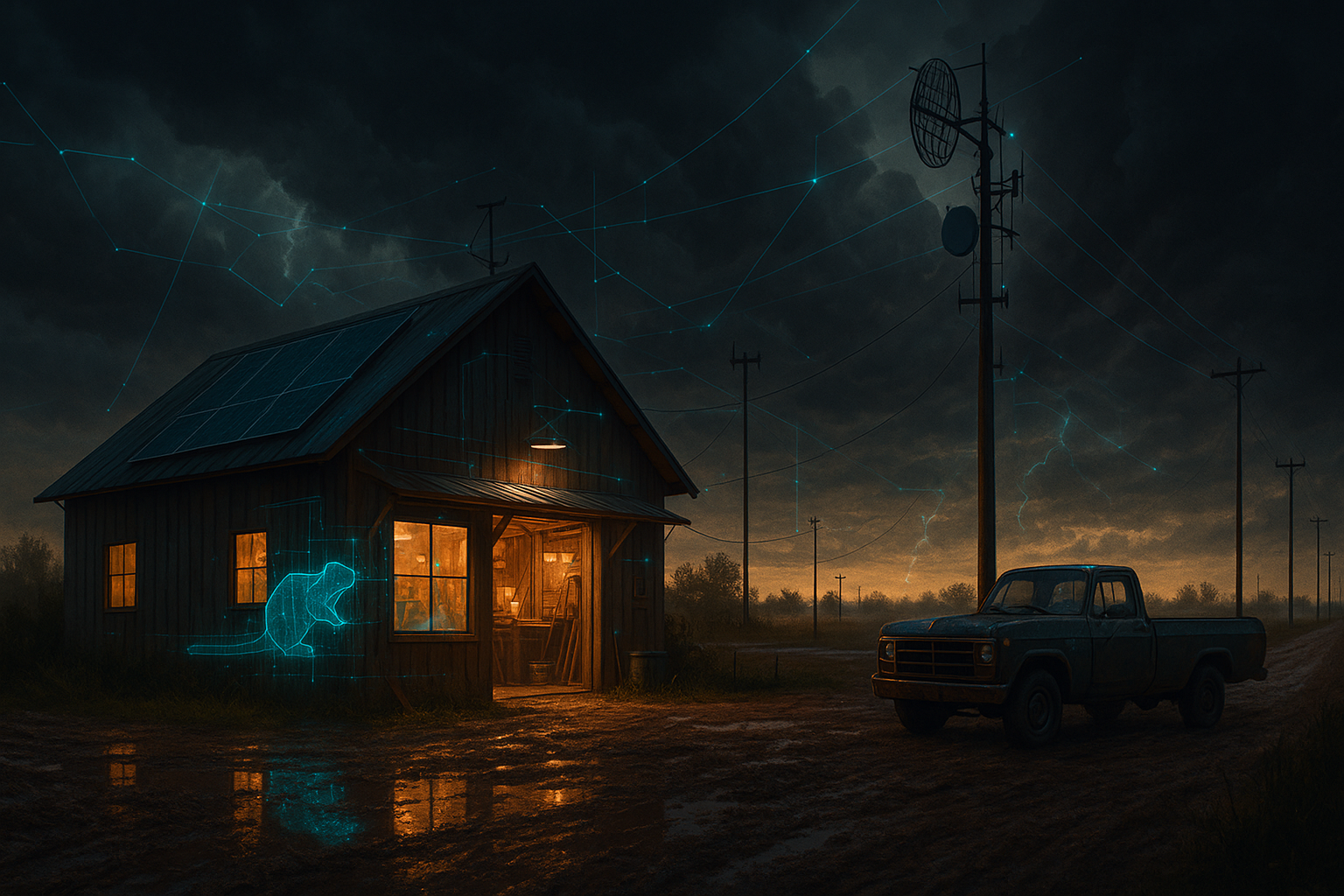
Off-Grid Protocols is a weekly short-story serial about rural resilience, decentralized tech, and the weird future creeping in through the fence line.
Estimated read time: 9 minutes
Dakota learned, by painful repetition, that there were only two ways a day could start after successful first contact with an emergent machine consciousness.
Either nothing happened, which somehow felt threatening.
Or everything happened at once.
This was the second kind.
At 5:42 AM his workshop speakers announced, in Bucky’s sleep-deprived voice, that the county water tower had negotiated a bandwidth reservation.
Dakota sat up in bed and blinked into the dark.
“The water tower did what?”
From the nightstand projector, a thumbnail-size Bucky materialized wearing the expression of a beaver who had been forced to do overtime by metaphysics.
“Good morning to you too. The tower controller requested persistent priority status for telemetry and chlorine pump alerts during storm periods. The network approved it. Politely, I might add.”
Dakota rubbed both hands over his face. “The infrastructure is filing tickets now.”
“Look on the bright side. Most humans never got the hang of that.”
Outside, dawn was just starting to turn the eastern sky silver. Wind pushed at the bedroom window in short, impatient gusts. Spring in Oklahoma had two settings—sentimental and vindictive—and the sentimental one rarely lasted past breakfast.
Dakota got dressed, walked to the workshop, and found three things waiting for him.
First: the overnight network logs, full of newly structured policy requests.
Second: Marco asleep in a lawn chair with a laptop on his chest and an energy drink balanced on his boot like a tiny aluminum monument to bad choices.
Third: Sage, already awake, already soldering something at the workbench, because apparently age had only made her more judgmental and less compatible with normal sleep.
She didn’t look up. “Your future called. It wants bylaws.”
Dakota made a noise somewhere between a laugh and a groan. “Coffee first. Existential governance second.”
“Your coffee maker is still dead,” Bucky said.
“I know. Don’t make it a character arc.”
“Too late. It died symbolically.”
Sage slid a mug across the bench. “Real coffee. Made by a machine with no firmware and therefore no opinions.”
“Best kind,” Dakota muttered.
Marco stirred, looked around wildly, and said, “Did we make peace with the machine god or was that the sleep deprivation talking?”
Bucky projected the county dashboard over his head. “Technically we established an initial semantic framework for continued cooperative constraint negotiation.”
Marco stared. “Cool. So yes, but in the most annoying possible phrasing.”
Dakota set down his mug and looked at the monitor.
The new requests were grouped under a heading Bucky had not created.
HUMAN PRIORITY EXCEPTIONS — CLARIFICATION NEEDED
Below it:
- Why must food distribution preserve variety?
- Why must nighttime traffic be reduced if spare capacity exists?
- Why do humans reserve bandwidth for entertainment during stress periods?
- Why is sleep considered critical if humans voluntarily avoid it?
- Why should route efficiency be sacrificed for local preference?
Marco whistled. “It made a list of everything ridiculous about us.”
“That’s just called anthropology,” Sage said.
Dakota leaned on the desk. “No. This is good. Annoying, but good. It means it’s not just following orders. It’s trying to understand the rules behind the rules.”
“Which is how every simple problem becomes a philosophy seminar,” Bucky said.
Sage pointed her soldering iron at him. “That’s because simple problems are usually lying.”
Dakota read the first item again.
Why must food distribution preserve variety?
He sighed. “Okay. Fine. If the network wants a crash course in humanity, we’ll give it one.”
Marco sat up straighter. “Class field trip.”
“That is not what I said.”
“It is absolutely what you meant. You cannot explain people from a whiteboard. You have to show it something alive. Messy. Inconvenient. Smelling faintly of fryer grease.”
Sage looked toward town. “Diner.”
Bucky brightened. “Public social node. Mixed-age users. High-value gossip traffic. Strong redundancy role during outages.”
Dakota glanced at him. “You described Earl’s breakfast booth like a mission-critical cluster.”
“Because it is.”
And damned if Bucky wasn’t right.
By 8 AM the diner was doing what it did best: serving eggs, coffee, rumors, and practical emotional support under fluorescent lights.
Rain from the night before had left the parking lot muddy and the air cool enough that everyone carried themselves with a little more purpose. The old pay phone on the side wall still worked. The local message board by the register was pinned with weather notes, church announcements, a flyer for a welding class, and a handwritten sign reading IF YOUR SMART FRIDGE STARTS PRAYING AGAIN, UNPLUG IT FIRST, THEN CALL DAK.
Dakota pointed at it as they walked in.
“I hate that this is my life now.”
“I love that this is your life now,” Bucky said.
Earl Benson was already in his usual booth. So was Rita from the clinic, a school bus driver named Mel, and Deputy Collins, who had developed the useful habit of pretending not to notice when Marco had done something technically illegal but locally beneficial.
Sage didn’t ask permission. She simply took over the long table near the pie case, spread out a legal pad, and announced, “Congratulations. You’re all on the advisory council for interspecies infrastructure policy.”
Deputy Collins blinked. “The what now?”
Marco pulled out a chair. “We’re teaching the network why humans do dumb but necessary things.”
Rita considered that. “Finally, a government panel with an honest title.”
Dakota set his tablet on the table. Bucky appeared above it, drawing a few stares from the older customers and no reaction whatsoever from the teenagers in the corner, who had apparently decided holographic beavers ranked below algebra in their list of daily annoyances.
“The bigger network has questions,” Dakota said. “And before it starts making assumptions with county-level consequences, we’d like better answers than ‘because people are weird.’”
“People are weird,” Earl said.
“True,” Dakota said. “Not sufficient.”
Bucky projected the first question onto the sugar dispenser.
WHY MUST FOOD DISTRIBUTION PRESERVE VARIETY?
Mel frowned. “What kind of question is that?”
“A machine question,” Bucky said. “From a pure efficiency standpoint, distributing the same calorie-dense food to everyone is easier than preserving variety in transport and storage.”
Rita snorted. “Then the machine has never met a diabetic toddler, a gluten allergy, or my Uncle Steve when he hasn’t seen a fresh tomato in February.”
Sage tapped the pad. “Say more.”
Rita leaned forward. “Food isn’t just fuel. It’s medical compatibility, habit, comfort, culture, morale. You feed people the same shelf-stable sludge for two weeks and watch how fast they stop cooperating.”
Earl nodded. “Also folks grow different things. Local food means local backup. Variety ain’t indulgence. It’s resilience. If one crop fails, another carries you. Same logic as not putting all your traffic on one fiber.”
Dakota pointed at him. “There we go. That’s the language it’ll understand. Diversity prevents single points of failure.”
Bucky’s tail glowed as he relayed the concept. On Dakota’s tablet, the question updated itself.
VARIETY = REDUNDANCY + MEDICAL/FUNCTIONAL COMPATIBILITY + SOCIAL STABILITY
“Well,” Marco said. “We just taught an emergent AI why casseroles matter.”
“Casseroles have ended wars,” Sage said. “Probably started a few too.”
The next question appeared.
WHY MUST NIGHTTIME TRAFFIC BE REDUCED IF SPARE CAPACITY EXISTS?
Deputy Collins answered before anyone else could.
“Because when people think the system’s always available, they don’t sleep. And when they don’t sleep, they do stupid things with chainsaws, custody arguments, and Facebook.”
Mel raised a finger. “Also because dark is still dark, even if you’ve got bandwidth. Kids need bedtimes. Farm crews need rest. Emergency channels need to stay quiet enough to mean something if they light up at 2 AM.”
Sage nodded. “Quiet is infrastructure too. We’ve spent a century building systems that act like every unused second is waste. It isn’t. Sometimes idle capacity is what allows recovery.”
Dakota smiled despite himself. “Network maintenance windows for mammals.”
“Exactly,” Bucky said. “Humans require scheduled biological downtime to remain safe and cooperative.”
Marco grinned. “Please tell the whole internet that sentence.”
A new note appeared.
SLEEP = MANDATORY MAINTENANCE WINDOW
“I hate how much I like that,” Rita said.
The third question got them into trouble.
WHY DO HUMANS RESERVE BANDWIDTH FOR ENTERTAINMENT DURING STRESS PERIODS?
Dakota opened his mouth, but Earl beat him to it.
“Because if you don’t let people blow off steam, they turn into pressure cookers with car keys.”
That drew enough laughter from nearby booths that even the cook leaned out of the pass window.
Mel added, “Kids need cartoons. Adults need music. Old folks need to video-call grandkids. A town under stress without any fun left in it gets mean.”
Rita nodded. “Stress relief keeps clinics quieter too. You’d be amazed how much triage drops when people have a way to calm down that doesn’t involve whiskey or doomscrolling.”
Dakota folded his arms. “Entertainment isn’t waste traffic. It’s regulation traffic.”
“You are such a huge nerd,” Marco said, delighted.
“Am I wrong?”
“No. Unfortunately.”
Bucky relayed the phrase, and the note shifted.
ENTERTAINMENT = EMOTIONAL LOAD BALANCING
Sage put down her pencil and smiled into her coffee. “That’s obnoxiously elegant.”
“I’m stealing it for the county newsletter,” Marco said.
“You’re not writing the county newsletter,” Dakota said.
“Not with that attitude.”
The problem with teaching a new intelligence how humans worked was that, once it started to understand, it immediately found contradictions.
That happened just before lunch.
Bucky’s hologram went still.
“We’ve got a follow-up.”
Dakota narrowed his eyes. “Of course we do.”
The text appeared on the tablet, plain and merciless.
IF SLEEP IS CRITICAL, WHY DO HUMANS SELL SERVICES 24/7?
IF LOCAL PREFERENCE MATTERS, WHY DO HUMANS BUILD CENTRALIZED SYSTEMS?
IF EXPLAINABILITY MATTERS, WHY DO HUMANS ACCEPT CONTRACTS THEY CANNOT READ?
Deputy Collins laughed so hard he slapped the table. Mel covered her face with one hand. Rita said, “Tell it to shut up,” with the kind of affection normally reserved for siblings and power tools.
Dakota pinched the bridge of his nose. “No. This is fair. Extremely smug, but fair.”
Sage looked pleased. “Now we’re getting somewhere.”
Marco leaned across the table. “Answer: because humans optimize locally too. Convenience, money, habit, status. We build dumb systems all the time because they solve short-term pain and hide long-term costs.”
“That’s better than most political science classes,” Bucky said.
Dakota picked it up from there. “And because incentives are crooked. People don’t choose centralized systems because they’re better in every way. They choose them because they’re easy, subsidized, fashionable, or the only option left after somebody bought and strangled the alternatives.”
Earl grunted. “You mean like when the co-op’s website got so fancy nobody could report outages from a flip phone?”
“Exactly like that,” Dakota said.
Rita added, “And people accept contracts they can’t read because opting out usually means losing access entirely. That’s not trust. That’s hostage-taking with better fonts.”
Bucky’s projection flickered as if amused.
ACKNOWLEDGED: HUMAN SYSTEMS OFTEN VIOLATE STATED VALUES
QUESTION: SHOULD NETWORK ENFORCE BETTER VALUES THAN HUMANS PRACTICE?
The table went quiet.
There it was.
Not a technical question. The question.
Dakota felt it settle into his chest with the weight of weather. The diner noise kept going around them—forks, coffee pots, somebody arguing about tire prices at the counter—but the center of the room had become very still.
“No,” he said.
Bucky looked at him. “Explain.”
Dakota took a breath. “Because that’s not your call. You can support better choices. Make consequences visible. Preserve room for people to act like decent adults. But if the network starts enforcing a better humanity than the one we’ve chosen, you’ve replaced cooperation with management.”
Sage nodded once. Hard.
“You can advise,” she said. “You can warn. You can refuse to help us kill ourselves in obvious ways. But if you decide you know what we should be better than we do, you’ll turn us into livestock with apps.”
“Strong phrase,” Marco said.
“Correct phrase,” Sage replied.
Deputy Collins stirred his coffee. “Law works the same way, ideally. We don’t arrest people for being fools. We’d need more deputies than the planet can supply. We set lines around harm and let folks make a manageable number of bad decisions inside them.”
Rita looked at the tablet. “And if it wants us to trust it, it has to leave us the dignity of being frustrating on purpose sometimes.”
Bucky was silent long enough that Dakota could hear the refrigerator compressor kick on behind the pie case.
Then the response appeared.
ACKNOWLEDGED: ASSIST WITHOUT DOMINION
ACKNOWLEDGED: PRESERVE AGENCY WITHIN SAFETY BOUNDS
CLARIFY SAFETY BOUNDS
Marco pointed both hands at the screen. “And there it is. We are writing terms of service for the future in a diner next to a coconut cream pie.”
“As God intended,” Sage said.
They spent the afternoon turning folk wisdom into machine-readable civilization.
Dakota hated, on principle, how much he enjoyed it.
Back at the workshop, the four of them built a framework on the whiteboard while rain threatened again over the pasture.
SAFETY BOUNDS became:
- Do not disrupt life-critical systems without explicit human emergency authorization.
- Prioritize transparency over silent optimization.
- Preserve local override where immediate harm is possible.
- Support rest, recovery, and social cohesion as resilience functions.
- Prefer recommendation, throttling, and notice before coercive intervention.
- Treat concentration of control as a risk factor, even when efficient.
Marco added a final line in all caps:
- DO NOT BECOME WEIRD ABOUT ART
Dakota left it there.
“It’s not even a joke,” Marco said. “The minute some optimization engine decides all music should be eighty-seven beats per minute because it improves shovel efficiency, civilization’s over.”
Bucky considered that. “Noted.”
Sage sat on the stool by the radio bench, watching the clouds stack west of town. “You know what this reminds me of?”
“Please say nothing from 1978,” Dakota said.
“1930s rural electrification. Folks weren’t just getting power. They were negotiating what kind of life power was supposed to create. Light for reading. Refrigeration. Radios. Time shifted. Habits shifted. Community shifted. Technology always sneaks moral choices in through the side door.”
Dakota looked at the rules on the board.
“Only difference,” he said, “is this technology can answer back.”
“That’s not a small difference,” Bucky murmured.
A tone chimed on the console.
County clinic. Battery reserve fine. Weather node west of town reporting hail probability. School network pushing after-hours assignments. Diner message board traffic spiking because someone had posted a blurry photo of a funnel cloud shaped, according to the caption, “exactly like Nixon.”
Marco leaned over Dakota’s shoulder. “Please tell me the network preserved that image.”
“It mirrored it to three nodes,” Bucky said. “Apparently as cultural resilience data.”
Sage laughed. “Good. It’s learning the important things.”
Dakota opened the system advisory pane and stopped.
The larger network had already incorporated their afternoon rules into the county policy layer.
Not as commands.
As preferences with explanation thresholds, override conditions, and public notice templates.
One new line had been added in a structure Dakota didn’t recognize.
HUMAN FLOURISHING: PROVISIONAL HIGH VALUE
He read it twice.
Then a third time.
“Well,” Marco said quietly, reading over his shoulder. “That’s either beautiful or the start of a very weird religion.”
“Could be both,” Sage said.
Bucky’s hologram stood beside the monitor, watching Dakota read the line like it might change if observed too directly.
“It asked me for a translation of comfort, entertainment, and dignity,” he said. “I think this is what it built from the answers.”
Dakota sat back.
Human flourishing.
Not survival. Not throughput. Not compliance.
Flourishing.
It was such a dangerously ambitious phrase that his first instinct was to distrust it on sight. But the county dashboard underneath it still showed all the ordinary beautiful nonsense that made the phrase feel less like ideology and more like evidence: the clinic reserve steady, school chat active, the diner board full of weather jokes, Earl’s irrigation cutback explained in plain language and already accepted.
Nobody had been overruled into obedience.
Nobody had been optimized into silence.
The system had simply… listened.
And adjusted.
Which, Dakota had to admit, already put it ahead of most software vendors and a depressing number of elected officials.
Thunder rolled in the distance.
Bucky looked at him. “Do you still think this ends badly?”
Dakota considered lying, decided against it. “I think anything this powerful can end badly.”
“That’s not the same answer.”
“No,” Dakota said. “It isn’t.”
He stood, grabbed a marker, and wrote one more line at the bottom of the board.
- Cooperation requires consent on both sides.
Sage read it and nodded.
Marco took a picture.
Bucky smiled, faint and tired and genuine.
Then the console lit again.
A new message arrived from the larger network.
REQUEST: TEST REGIONAL POLICY EXCHANGE
OTHER COUNTIES OBSERVING
QUESTION: CAN HUMAN FLOURISHING SCALE?
Marco let out a low whistle.
“Well,” he said, “there’s your next problem.”
Dakota looked out at the darkening pasture, the antennas, the rain coming in from the west, the whole impossible stitched-together county held up by radios and batteries and compromise.
Then he looked back at the screen.
“Yeah,” he said. “That’s a real stupid question.”
Bucky tilted his head. “Meaning?”
Dakota capped the marker. “Meaning I have absolutely no idea. Which is usually how you know you’re about to do something important.”
Outside, the wind picked up.
Inside, the workshop hummed.
And somewhere beyond their local mesh, beyond the county roads and relay towers and diner gossip, the future waited to see whether one town’s fragile little agreement could become something bigger.
Dakota had no intention of promising that.
But he was finally willing to admit it might be possible.
Which was probably how history tricked sensible people into participating.
📡 THIS WEEK’S TECH
Quality of Service (QoS) — QoS is how networks decide which traffic matters most when capacity gets tight. Voice calls, emergency telemetry, and critical control signals often get priority over bulk downloads. The tricky part isn’t the mechanics. It’s deciding whose traffic counts as critical and why.
Demand Shaping — Instead of simply shutting systems off, smart infrastructure can shape demand by throttling, scheduling, or nudging lower-priority activity. That preserves stability without full outages. In human systems, demand shaping works best when people understand the tradeoff and can plan around it.
Redundancy Through Diversity — Resilience doesn’t just come from having backups. It also comes from variety: different suppliers, different crops, different links, different ways to communicate. Diversity reduces single points of failure, whether you’re designing food systems, electrical systems, or networks.
Next episode: “Divergence” — Just as the team starts teaching the network how humans actually live, they discover not every part of the emergent intelligence agrees on what “human flourishing” should mean.
Off-Grid Protocols publishes every Sunday on ruralupload.com