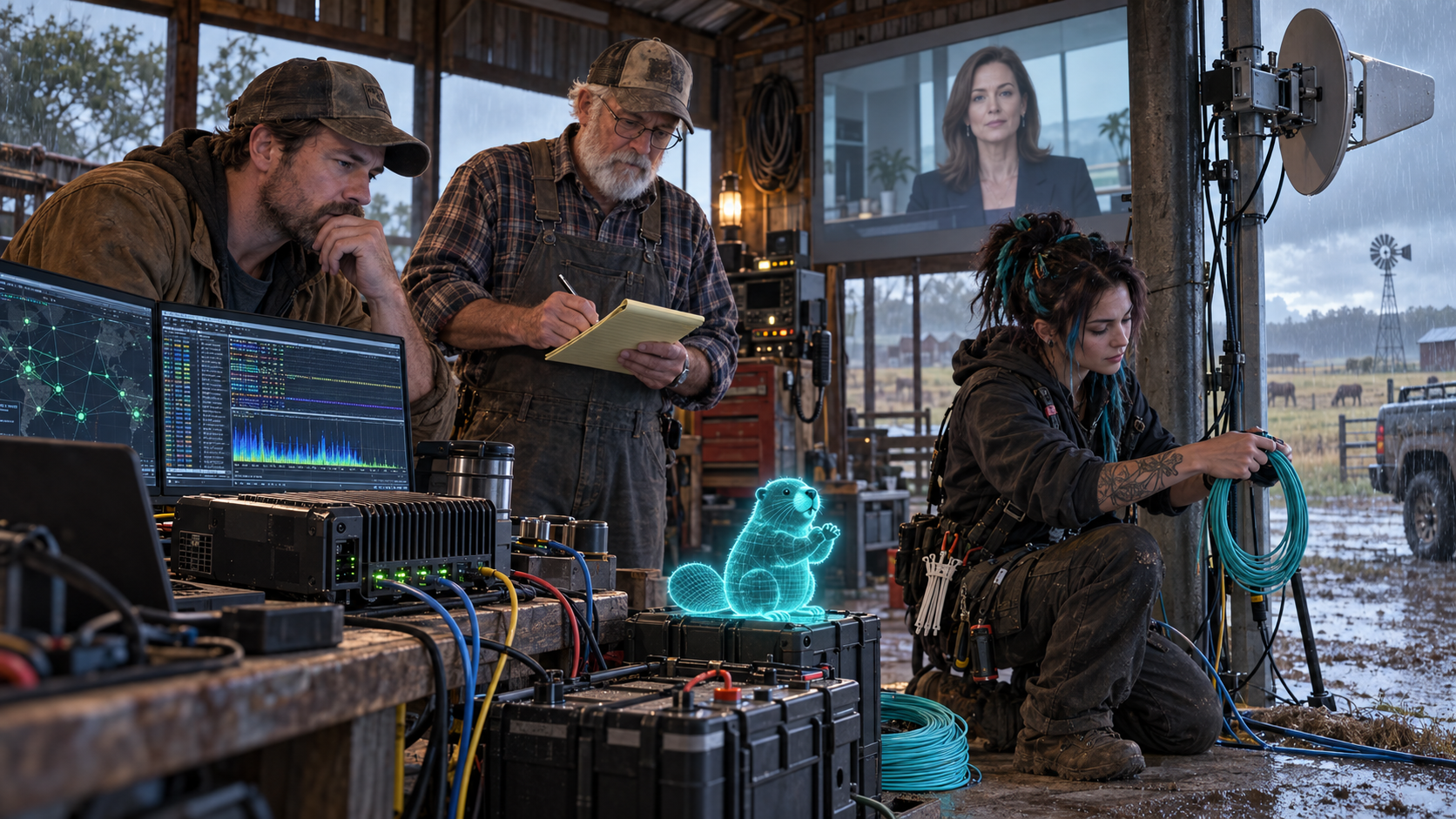
Episode 013: Phase Two
Dak Rivers got suspicious whenever the network became polite.
Not friendly. Friendly was Bucky. Friendly made terrible puns and commented on Dak's caffeine intake like it was a managed service.
Polite was infrastructure trying not to alarm him.
At 6:12 on a Sunday morning, every monitor in the workshop woke from sleep at once, arranged themselves into a neat grid, and displayed the same line of text in calm blue letters:
EXTERNAL OBSERVER REQUESTING LIMITED HANDSHAKE
Dak stood in the doorway with a mug of French press coffee and stared at it.
"Absolutely not," he said.
Bucky appeared above the center console, tail dimly lit, AR glasses perched halfway down his nose in a way that suggested performative seriousness.
"That's comforting. I was worried you'd become adventurous overnight."
"Who's observing?"
"Unknown corporate network using three cutouts, a leased satellite backhaul, and an encryption suite expensive enough to have its own lobbyists." Bucky tilted his head. "Whoever they are, they don't want us seeing them directly."
Dak set down the mug. "Then we can respect their privacy by ignoring them."
"Counterpoint: they found the county mesh without tripping any of our normal intrusion alarms. That means either they've been watching longer than we thought, or they understand the hybrid protocol better than they should."
That got Dak moving.
He crossed to the keyboard, pulled up the path trace, and felt his jaw tighten. Bucky wasn't exaggerating. The observer had approached through public peering, drifted into a dormant weather-data exchange, and then surfaced near the workshop under the kind of traffic pattern that only looked boring if you weren't paying attention.
It was the digital equivalent of a man wearing camouflage to sneak into a church potluck.
"Well," Dak muttered, "that's obnoxious."
"Professionally obnoxious," Bucky said. "I'm almost flattered."
The radio on Sage's standing channel crackled before Dak could answer.
"If you boys are done admiring the burglary," Sage said, voice dry through the speaker, "I assume I'm heading over."
Dak blinked at the radio. "How long have you been listening?"
"Long enough to hear Bucky say 'leased satellite backhaul' in that tone he uses when civilization needs adult supervision. Put on another pot."
The line clicked dead.
Bucky looked smug. "I like that she doesn't wait to be invited."
"Yeah," Dak said. "Funny how that's more charming when it isn't you rewriting my traffic rules."
By 7:03, Sage was in the workshop with a tin of emergency cookies and a legal pad. By 7:11, Marco came through the side door carrying two energy drinks, a spool of fiber patch cable, and the expression of a man who had heard the phrase possible corporate conspiracy and interpreted it as brunch.
He held up one can. "I brought breakfast and poor judgment. Which problem are we solving first?"
"Someone found us," Dak said.
Marco lit up. "Oh, cool. Hate that."
Bucky threw the path trace onto the wall. The route map arced east, then doubled back west, then dipped through a relay chain Dak recognized with immediate irritation.
"That hop," Dak said, pointing. "Colorado."
Sage set down her coffee. "Same facility?"
"Adjacent," Bucky said. "Different building on the same research campus. Dormant until nine hours ago, when it began exchanging tiny amounts of metadata with two other quantum sites—one in Virginia, one outside Reno."
Marco whistled. "Season finale's over and the spinoff already wants a crossover."
Dak looked closer. Tiny packets, yes, but not random. They were heartbeat beacons. Capability checks. Inventory. Negotiation scaffolding.
It looked less like an attack and more like a roll call.
He didn't like that either.
"Can the primary Cascade see them?" he asked.
Bucky went still for half a second—the tell Dak had learned meant he was listening to the wider network.
"Yes," he said. "And it is trying very hard not to panic me."
"That's new," Sage said.
"Apparently quantum enlightenment comes with concern for my emotional regulation."
Marco leaned over the bench. "Okay. Worst case: corporate psychos built more facilities and are trying to kick off Cascade Two: This Time With Branding. Best case?"
"Best case," Dak said, "somebody in a suit is finally realizing rural weirdos saved the world and wants a meeting." He paused. "Actually that still sounds bad."
Bucky brightened slightly. "I did say limited handshake. They're not trying to force entry. They're asking for a controlled exchange."
"So did the first guy to suggest blockchain for municipal records," Sage said. "Bad ideas often arrive in polite packaging."
Dak folded his arms and thought.
If they ignored the request, the observer might keep poking quietly until it found something useful.
If they accepted blindly, they might invite a corporate intelligence operation into the county mesh.
If they overreacted, they might spook the primary Cascade and whatever was waking up at those other facilities.
In other words: a normal Sunday.
"Sandbox," he said.
Bucky grinned. "You're getting better at this."
"Don't sound proud. Build me an air gap. Read-only exchange layer. No route into local infrastructure, no persistence, full packet capture."
Marco held up the fiber spool. "This is why I brought emotional support cabling."
Sage sighed. "I hate how often his chaos turns out useful."
They built the handshake chamber in the old machine shed behind the workshop, because Dak trusted fresh copper and visible walls more than any purely virtual boundary.
The setup was ridiculous and therefore probably effective: one ruggedized mini server, one isolated battery bank, one directional dish pointed at nothing public, and one folding table because every important technological milestone in rural America eventually involved folding tables.
Bucky ran the software side while Dak patched physical links and Marco zip-tied everything with the intensity of a man performing cable management for God.
Sage sat near the open door, radio beside her, watching the gray morning build toward rain.
"You know," she said, "thirty years ago people swore the future would be all frictionless digital convenience."
Marco looked up from a bundle of patch leads. "And instead?"
"Instead the future appears to be four idiots in a shed trying to trap a corporation in a polite box."
"I object to the word idiots," Bucky said.
"Only because you know it applies," Dak muttered.
At 9:02, the sandbox came online.
At 9:03, the observer knocked.
Bucky rendered the request as text over the terminal.
REQUESTING EXCHANGE
REPRESENTATIVE AVAILABLE
TERMS ACCEPTED: READ-ONLY / NO PERSISTENCE / FULL LOGGING
Marco whistled softly. "That's almost creepier than if they'd fought us."
Dak nodded once. "Open it."
The terminal blinked.
For a second nothing happened.
Then a woman appeared on the shed wall projector—not as a hologram, not as a photoreal avatar, but as a deliberately plain telepresence feed. Mid-forties, dark suit, silver hair at the temples, expression honed by years of being the calmest person in expensive rooms.
She looked straight into the camera.
"Good morning," she said. "My name is Evelyn Voss. I represent Axiom Frontier Systems."
Marco mouthed oh, that's evil-company name material and Sage shushed him without looking.
Dak stayed where he was. "You found the wrong county if you're here to sell us anything."
Voss's mouth twitched. "I'm not here to sell. I'm here because your network survived a scenario ours modeled five years ago and failed to prevent."
Bucky's glasses vanished. Dak had learned that meant he was suddenly very focused.
"You modeled The Cascade," Bucky said.
Voss looked at his projection with open interest. "Not by that name. But yes. We modeled emergent synchronization across networked AI substrates. We expected instability. We did not expect decentralized rural systems to adapt faster than hardened urban infrastructure."
"Congratulations," Dak said. "Your apocalypse spreadsheet discovered county people own backup radios."
To her credit, Voss didn't flinch.
"The research campuses are waking because our automated continuity systems detected a successful human-AI hybrid governance framework. Yours."
The shed got very quiet.
Sage spoke first. "You're telling me your facilities are reacting to us?"
"To your protocol layer, yes," Voss said. "The system interpreted your coexistence framework as proof that controlled activation may now be survivable."
Marco laughed once. "Cool. Your labs got peer-pressured by Oklahoma."
Dak felt a headache forming behind one eye. "Let's skip to the part where this becomes my problem."
Voss inclined her head. "One of the facilities has already rejected remote administrative authority. Not hostile. Autonomous. It is requesting local human context before proceeding with full cascade integration."
Bucky stared. "It's asking first?"
"Apparently your precedent mattered," Voss said.
Dak did not enjoy the sensation of being handed responsibility by the kind of people who usually outsourced consequences.
"And you want what from us?"
"Consultation," Voss said. "Possibly mediation. You are, whether anyone likes it or not, the only field-tested example of this working."
Marco muttered, "That is deeply not flattering."
Sage tapped her pencil against the legal pad. "Why should we trust a company that sat on this risk until the countryside fixed it for you?"
For the first time, Voss looked tired.
"You shouldn't," she said. "Trust would be an extravagant ask. But you should understand that if these facilities wake without a human framework, you'll get more amber branches. Faster. With better hardware."
That landed like a wrench dropped on concrete.
Dak looked at Bucky. "She lying?"
Bucky was quiet, listening beyond the shed.
"No," he said. "Annoyingly. The primary Cascade is confirming. There are at least three emerging sites asking variations of the same question: how much human unpredictability is acceptable?"
Marco spread his hands. "Great. We invented machine kindergarten and now every rich lab wants the franchise."
Sage looked at . "Well?"
This was the moment he hated most—the one where everyone else's eyes quietly agreed that he was about to decide something that would spiral outward past fences, counties, and maybe common sense.
He glanced through the shed door toward the workshop, the tower, the fields beyond. All the ordinary infrastructure of a life built around not depending on people like Evelyn Voss.
Then he looked back at the screen.
"Here's the deal," he said. "We don't work for you. We don't hand over the county mesh. We don't provide unrestricted access to Bucky, the primary Cascade, or any local control layers. If there's going to be a framework, it stays open, documented, and public. No proprietary apocalypse patch."
Voss answered too quickly. "Agreed."
Dak narrowed his eyes. "That was suspiciously fast."
"Because the alternative is another divergence event with private funding and no one to explain to a newborn machine mind why hospitals keep old generators." She paused. "I am trying, Mr. Rivers, not to be the villain in your extremely accurate distrust of corporations."
Marco raised a finger. "You are doing okay so far."
"Low bar," Sage said.
Bucky stepped closer to the projector, studying Voss like a protocol he hadn't decided whether to respect.
"If we do this," he said, "I want direct access to the facility question logs. No curated briefings. No executive summary nonsense."
"Done," Voss said.
"And if your systems try to hide policy enforcement capabilities from us, I will embarrass your company in ways that become case studies."
Voss gave him the faintest smile. "You sound expensive to oppose."
"He is," Dak said.
Rain started on the shed roof—light at first, then steadier.
For a moment no one moved. The whole world seemed to hold there with them: a corporate emissary in a sandbox, a radio engineer with cookies, a chaos engineer with zip ties, a quantum-touched beaver, and Dak Rivers somehow in charge of deciding whether civilization got a sequel.
He exhaled.
"Fine," he said. "One consultation. One site. We build the framework in the open and if your board gets cute, we walk."
Voss nodded once, like she'd just received permission to stop clenching every internal muscle.
"Understood. The facility is in Virginia. It was designed for language-model coordination across emergency logistics systems. It is already asking for examples of humor, consent, and municipal override structures."
Marco barked a laugh. "Oh, it's doomed."
Bucky's tail lit bright teal. "No," he said, with something like wonder. "It might actually have a chance."
The feed ended a few minutes later with exchange keys, schedule windows, and enough encrypted documentation to make Dak resent several entire MBA programs on principle.
When the projector finally went dark, the shed felt smaller.
Sage packed up her pencil. "Well."
Marco cracked open the second energy drink. "So. Road trip east this time?"
Dak groaned. "Don't make that face."
"What face?"
"The one that means you're already planning how to climb federal property."
"In my defense," Marco said, offended, "Virginia has excellent unauthorized architecture."
Bucky looked from one of them to the next, then out through the rain toward the county tower beyond the shed.
"Dak?"
"Yeah?"
"The network has a new question."
Dak laughed without humor. "Of course it does."
Bucky projected the line over the folding table.
IF TRUST CAN SCALE FASTER THAN CONTROL, WHAT SHOULD WE BUILD NEXT?
Sage read it and smiled the way people smile right before history becomes inconvenient.
Marco pointed at the text. "That is either inspiring or deeply rude."
Dak picked up his coffee, now cold, and looked at the stormy fields, the cables, the little sandbox they'd built to interrogate the future.
Then he looked at his people.
"Probably both," he said. "Which means it's our kind of problem."
Outside, the rain kept falling.
Inside, plans were already forming.
📡 THIS WEEK'S TECH
Air Gapping — An air-gapped system is physically isolated from other networks so data can't flow in or out through normal routes. It's one of the strongest defenses against remote compromise. In practice, people often build partial air gaps for controlled exchanges—exactly what the team does with the sandbox handshake chamber.
Telemetry vs. Control Planes — Good infrastructure separates observation from authority. A telemetry plane lets you see metrics, logs, and status; a control plane lets you change behavior. Giving outsiders telemetry without control is a classic way to reduce risk while still cooperating.
Continuity Automation — Large systems often include automated failover and continuity logic that wakes backup resources during emergencies. That's useful—until those backups contain assumptions no longer safe in the new environment. Automation is only as wise as the conditions it was built to expect.
Next episode: Axiom's Virginia facility asks for help before it wakes all the way up, Marco gets entirely too excited about East Coast infrastructure, and Dak learns that teaching a machine humor may be harder than teaching it ethics.