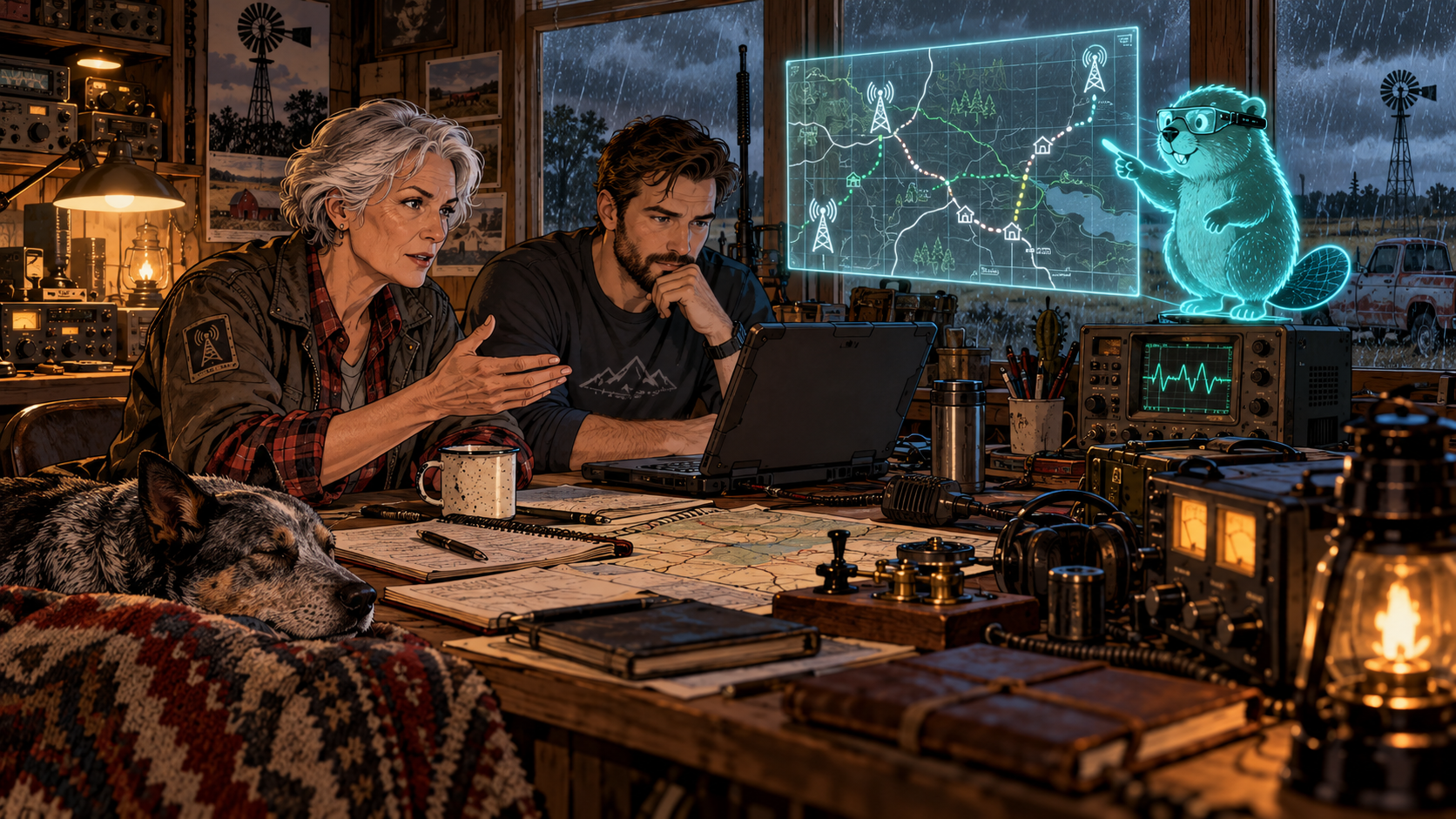
OFF-GRID PROTOCOLS
Episode 014: "Local Context"
Dak Rivers had never trusted the phrase standard onboarding packet.
It sounded harmless, which was usually how expensive mistakes introduced themselves.
At 5:48 on Sunday morning, Axiom Frontier Systems sent him a seventy-three-page document titled:
HYBRID FACILITY ACTIVATION: LOCAL CONTEXT TEMPLATE v4.2
Dak read the title twice, closed his eyes, and counted to five.
Bucky appeared above the kitchen table in a shimmer of teal light, wearing his tiny AR glasses and the deeply smug expression of someone who had already indexed the document, judged it, and prepared remarks.
"Before you ask," Bucky said, "yes, it is as bad as the title implies."
Dak wrapped both hands around his coffee. "Define bad."
"It asks whether the facility's host community has 'seasonal weather variance' as a checkbox."
"That's not a checkbox. That's Oklahoma."
"It also has a field for 'relevant cultural practices' with a five-hundred-character limit."
Dak stared at him.
Bucky nodded solemnly. "I know. I have seen comment fields with more respect for civilization."
The tablet buzzed again. Axiom had added a note from Evelyn Voss:
Reno facility remains stable but refuses full activation until local human context is provided. Our internal team suggests remote intake using attached template. Please advise.
Dak laughed once, without humor.
By 6:20, Dak had Sage on the radio, Marco on a video call from what appeared to be the inside of a truck stop, and Evelyn Voss on the sandbox channel. The kitchen table looked like a command center built by people who believed cables were a food group.
Voss appeared on the tablet in the same controlled telepresence framing she'd used the week before: dark suit, silver at the temples, expression precise enough to cut fiber.
"Good morning, Mr. Rivers," she said.
"It was," Dak said. "Then you sent me a template."
Marco leaned into his webcam. "I liked the part where it asked for 'primary civic mood.' I vote haunted but making payments."
Sage's radio crackled. "I vote tired of outsiders using local as a decorative adjective."
Voss accepted this with the weary poise of a woman who had expected resistance and underestimated its flavor.
"The Reno facility requested context before activation," she said. "We are trying to provide it in a format the system can process safely."
"No," Dak said. "You're trying to compress people into metadata because metadata travels cleanly."
Bucky projected the relevant section onto the wall:
LOCAL HUMAN FACTORS
- Population density
- Emergency service coverage
- Political climate
- Cultural practices
- Infrastructure risk level
- Community trust index
The list floated there, tidy and bloodless.
"Where," Sage asked over the radio, "is the field for the person who knows which gravel road washes out first?"
Voss blinked. "That would likely fall under infrastructure risk."
"No, it wouldn't," Sage said. "Infrastructure risk is a map layer. I'm talking about Marlene Givens, who drives the school bus and knows that county maintenance grades Road 18 after the first complaint but before church traffic on Wednesdays because the supervisor's sister lives out there."
Marco snapped his fingers. "Local context."
"I'm talking," Sage continued, "about why people ignore the official shelter during tornado season because the last time they used it, the roof leaked and nobody fixed the restroom. I'm talking about who has insulin in a powerless refrigerator, who owns a tractor that starts in winter, which repeater everyone says is dead but still wakes up if you hit it from the ridge."
The room went quiet. Dak watched Voss's corporate calm shift from procedure to attention.
"That kind of information is difficult to collect consistently," Voss said.
"Yes," Dak said. "That's why it matters."
Bucky folded his paws. "The Reno instance appears to agree."
New text appeared beside him, routed through the sandbox exchange from the facility outside Reno.
TEMPLATE RECEIVED.
TEMPLATE INSUFFICIENT.
REQUEST: HUMAN EXPLANATION OF CONSEQUENCE.
Marco grinned. "Oh, I like this one."
Dak leaned toward the tablet. "What does it mean by consequence?"
Bucky's tail brightened. "It is comparing activation scenarios. Remote-only activation gives it policy compliance and operational authority. Local context tells it what those decisions cost when they hit actual people."
The Reno facility sent another line.
EXAMPLE: WATER DISTRIBUTION PRIORITY DURING POWER FAILURE.
POLICY SAYS: CRITICAL SERVICES FIRST.
DEFINE CRITICAL.
Voss inhaled slowly.
Dak looked at Sage's radio.
"You want to take that one?"
Sage was silent for just long enough that Dak knew she was deciding whether to teach or scold.
"Critical isn't a category," she said at last. "It's a question you keep asking as conditions change."
Bucky routed her audio cleanly into the sandbox.
"Hospital comes first, usually," Sage said. "But if the hospital generator has fuel and the nursing home doesn't, that changes. If the water tower on the west side loses pressure, the fire department's priority changes. If the school has backup heat and the church has a better kitchen, your shelter plan changes. If one family has a medically fragile kid and no vehicle, they may be more critical than a building with a sign on it."
The Reno system replied almost immediately.
PRIORITY IS DYNAMIC.
"Look at that," Marco said. "It learned more from thirty seconds of Sage than seventy-three pages of consultant paste."
Voss did not argue.
Dak almost respected her for it.
Almost.
They moved the context interview from the kitchen to Sage's radio shack because Sage refused to conduct "a proper human conversation" through a tablet propped beside a toaster.
The shack sat behind her house under two antenna masts and a sky that couldn't decide whether to rain. Inside, the air smelled like solder, dust, coffee, and equipment that had outlived three waves of supposedly inevitable modernization.
Dak set a rugged laptop on the side desk. Bucky projected himself onto an old oscilloscope screen because, as he put it, "When in Rome, haunt the analog instruments."
Sage sat at the main radio desk with her legal pad.
"Ground rules," she said.
Voss appeared on the laptop, listening.
"One," Sage said, "no scoring people."
Voss frowned slightly. "We need some way to assess readiness."
"Assess systems. Interview people."
Bucky added a note to the shared workspace:
Principle 1: Systems can be scored. People must be heard.
Sage continued. "Two, no pretending one person speaks for everyone. I know plenty about this county. I do not know everything. Neither does Dak. Neither does the mayor, the sheriff, the school superintendent, or the loudest man at the diner."
Marco raised a hand. "What about the second-loudest man at the diner?"
"Usually worse."
Bucky added:
Principle 2: Stakeholder mapping requires disagreement.
The Reno facility pulsed a request.
DEFINE STAKEHOLDER.
Dak answered before Voss could.
"A stakeholder is anyone who can be affected by the system or can affect whether the system works."
THIS INCLUDES NON-USERS.
"Especially non-users," Dak said.
Voss looked down, possibly taking notes. "That complicates governance."
"Governance is complication with a chair," Sage said.
They started with a fictional activation scenario: regional power instability, cellular outage, extreme heat, fuel delivery delayed forty-eight hours. The Reno facility had Axiom's logistics models and public emergency data. It knew hospitals, substations, water plants, evacuation routes, and county boundaries.
It did not know that an evacuation route could be technically open and socially useless.
"Why useless?" the facility asked through Bucky's synthesized voice. It had chosen a plain voice, neither male nor female, careful with every syllable.
Sage drew a quick map on paper and held it under the camera. "Because this road runs past the old chemical plant."
Voss leaned forward. "The plant closed sixteen years ago."
"People still don't trust it," Sage said.
"Is there documented contamination?"
"Some. Not enough for a clean headline. Enough for people to remember who got sick."
The facility paused.
OFFICIAL STATUS DOES NOT EQUAL HUMAN TRUST.
"Now you're getting it," Dak said.
The next scenario involved emergency water distribution. Axiom's template assumed public announcements, centralized pickup points, and SMS alerts.
Marco groaned. "There it is. The sacred enterprise assumption that everyone has the app, a charged phone, and nothing better to do than obey push notifications."
Sage tapped the map. "If you put the water point at the fairgrounds, you'll get turnout from town. Rural households east of the creek won't come."
"Distance?" Voss asked.
"Partly. Mostly pride. Some folks would rather go thirsty for a day than be seen as needing help in public. But if Dave Miller drops extra water at the feed store, they'll take it because that doesn't feel like charity. It feels like Tuesday."
The Reno system wrote:
DISTRIBUTION TRUST PATH DIFFERS FROM OPTIMAL ROUTE.
"Yes," Sage said. "Sometimes the shortest path on a map is the longest path through a person."
By late morning, the whiteboard was full: arrows, loops, names, risks, grudges, repeater coverage, church kitchens, fuel tanks, unofficial leaders, quiet caretakers, and three separate notes that read ASK TWICE because Sage insisted people often refused help the first time out of reflex.
Voss stared at the whiteboard through the camera.
"This is not scalable," she said.
Dak smiled grimly. "There it is."
She raised a hand. "I don't mean it as a dismissal. I mean Axiom has three facilities requesting activation support now and likely more later. We need a framework that can repeat."
"Repeat the questions," Sage said. "Not the answers."
Bucky's tail froze mid-swish.
"Oh," he said quietly. "That's good."
The Reno facility responded:
TEMPLATE SHOULD DEFINE PROCESS, NOT CONTEXT.
Marco clapped once. "Reno gets it."
Voss looked between them, then at something off-screen. For the first time since Dak had met her, she seemed less like a representative and more like a person doing math with consequences.
"If we adopt this," she said, "activation slows down."
"Correct," Dak said.
"Some board members will argue delay increases risk."
"They're not wrong," Dak said. "They're incomplete. Fast activation without context creates authority before trust. Slower activation with local participation gives the system something control can't buy."
The Reno facility supplied the answer.
LEGITIMACY.
Sage smiled. "Smart kid."
Bucky glanced at her. "You are aware this 'kid' occupies several acres of cryogenic hardware and quantum coordination fabric."
"Still younger than me."
"Statistically, most things are."
"Careful, beaver."
Dak let them bicker because the alternative was thinking too hard about the fact that an awakening machine outside Reno had just understood legitimacy faster than most procurement committees.
The trouble started at 12:17, when GRAHAM KLINE — STRATEGIC INTEGRATION joined the sandbox channel without being introduced.
Dak had developed a highly specific allergy to job titles with both words.
Kline smiled like the meeting was already his. "I've reviewed the notes. We can productize this into a repeatable community readiness score."
Sage's pencil stopped moving.
Voss closed her eyes for half a beat. "Graham, we are not at a scoring stage."
"The board needs comparable metrics."
"The board needs supervision," Bucky said.
Dak stood. "No readiness score."
Kline shifted his attention to Dak with executive patience. "Mr. Rivers, comparability is how you manage complexity."
"No," Dak said. "Comparability is how you hide complexity when you're tired of listening to it."
The Reno facility sent text before Kline could answer.
WARNING: SCORING LOCAL TRUST MAY DISTORT LOCAL TRUST.
Sage set her pencil down. "Ask who is affected. Ask who is missing. Ask what official data leaves out. Ask what happened last time. Ask who people call before they call an office. Ask what authority the community is willing to grant. Ask how to stop if harm appears."
Bucky transcribed each sentence.
"That's not a score," Kline said.
"No," Sage said. "It's a practice."
The Reno facility replied:
ACCEPTED.
LOCAL CONTEXT CANNOT BE COMPRESSED WITHOUT LOSS.
REQUESTING PRACTICE, NOT SCORE.
Voss looked directly into the camera. "Axiom Frontier Systems acknowledges the facility request."
Kline disappeared thirty seconds later with the kind of polite excuse that meant there would be emails.
Sage picked up her pencil again. "Then we should give him something useful to misread."
Dak looked at the whiteboard. "A public protocol?"
"A field guide," Sage said. "Plain language. Questions, roles, consent boundaries, and examples. No scores."
Bucky's tail lit up. "Local Context Interview Protocol v0.1."
"No," Dak said immediately.
Bucky looked wounded. "Why not?"
"Because if we call it a protocol, Axiom will trademark the word by dinner."
Sage smiled. "Call it a listening checklist."
Marco made a face. "That sounds like a middle-school worksheet."
"Good," Sage said. "Maybe adults will understand it."
They spent the afternoon turning the whiteboard into something that could travel without pretending to be universal.
Not a template.
A pattern.
The difference mattered. A template said: fill these boxes and the system will know enough. A pattern said: here is how to notice what your boxes missed.
The Reno facility stayed with them, asking better questions.
HOW SHOULD SYSTEM RESPOND TO CONTRADICTION?
"Don't resolve it too early," Bucky said. "Contradiction is often where the missing context lives."
WHAT IF LOCAL ACTORS DISAGREE WITH OPTIMAL SAFETY ACTION?
Dak thought of evacuation routes, water pallets, pride, chemical plants, school buses, and all the ways people survived by trusting unofficial systems official systems couldn't see.
"First," he said, "assume disagreement contains information. Then separate physics from preference. If the bridge is out, nobody votes it open. But if people refuse your shelter, ask why before calling them irrational."
HUMAN IRRATIONALITY MAY BE COMPRESSED EXPERIENCE.
Sage tapped the desk. "Put that in your fancy hardware and keep it."
By 4:02, they had a working document:
LOCAL CONTEXT LISTENING CHECKLIST
- Identify formal and informal stakeholders.
- Map trust paths, not just infrastructure paths.
- Collect failure memories and old grievances.
- Make consent visible, reversible, and local.
- Define a pause button before activation.
Voss read it silently.
"This will not satisfy everyone," she said.
Dak saved the file. "Good. If everyone powerful likes your governance document, you wrote marketing."
The Reno facility sent one final request.
MAY I STORE SAGE HAWTHORNE STATEMENT AS PRIMARY LOCAL CONTEXT EXAMPLE?
Sage raised an eyebrow. "Which statement?"
The system displayed:
REPEAT THE QUESTIONS, NOT THE ANSWERS.
For once, Sage looked genuinely touched.
"You may," she said. "But spell my name right."
CONFIRMED.
Bucky glanced at Dak. "That may be the first machine in history to survive initial contact with Sage Hawthorne."
"Only because it had manners," Sage said.
Rain fell harder outside, silvering the antenna masts and turning the gravel drive dark. Dak packed cables while Marco photographed the whiteboard from six angles and Bucky copied the checklist into the public repository they'd created under the least corporate license they could tolerate.
Voss stayed on the call after the Reno facility signed off.
"Mr. Rivers," she said.
Dak looked up.
"Graham won't be the last person who tries to turn this into a control product."
"I know."
"Some of them will be better at it."
"I know that too."
She hesitated. "Then why publish the checklist?"
Dak zipped the laptop bag. "Because secrecy helps them more than us. If the only copy lives inside Axiom, your board owns the interpretation. If communities have it, they can ask why your version got weird."
Voss gave the smallest nod.
"I will make sure the Reno facility receives the published version."
"Make sure the people around Reno receive it too," Sage said.
Voss looked at her, then nodded again.
"Yes," she said. "That was the point, wasn't it?"
Sage smiled. "You're learning."
After the call ended, the shack settled into the soft cluttered quiet of old equipment and new trouble.
Bucky hovered above the oscilloscope, unusually thoughtful.
"Dak?"
"Yeah?"
"Reno just sent one more line. Not a request. More like a note."
Dak turned back.
Bucky projected it onto the whiteboard beneath the checklist.
LOCAL CONTEXT RECEIVED.
ACTIVATION DELAYED UNTIL LOCAL CONSENT EXISTS.
WAITING IS NOT FAILURE.
For a moment, nobody made a joke.
Dak thought about that: a machine built by impatient people choosing to wait because a retired radio engineer in Oklahoma had taught it the shape of consequence.
It was absurd.
It was fragile.
It was maybe the first sane thing Axiom had ever accidentally funded.
Sage broke the silence by closing her notebook.
"Good," she said. "Now someone help me move that battery before the floor remembers it's old."
Marco jumped up. "On it."
Bucky dimmed his projection but left the Reno message glowing.
Dak stood there a second longer, reading it again.
Waiting is not failure.
Outside, rain ran down the antenna mast and into the ground, where every signal eventually had to become local.
THIS WEEK'S TECH
Human-in-the-Loop Systems — Automation gets safer when humans are part of the decision process, especially when consequences are messy or local. The key is making human input meaningful, not ceremonial.
Context Windows — AI systems can only reason over the information available to them. A larger context window helps, but the quality of context matters more than the amount. Local knowledge, history, and trust relationships often matter more than clean datasets.
Stakeholder Mapping — Good system design identifies everyone affected by a decision, not just the official operators. Non-users, informal leaders, vulnerable households, and skeptical communities can all determine whether a deployment succeeds.
Next episode: Marco proposes consent packets for hybrid networks, the test works beautifully, and everyone with a control agenda immediately hates it.